Showing posts with label book. Show all posts

Wednesday, 11 January 2023

Karl Bartos:The Sound of the Machine


I had a German language edition of this 2017 book already a few years back, but after struggling through few pages I gave it up. Now I'm holding the 2022 English edition in my hands.

Although this is an artist autobiography of Karl Bartos, it also tells the story of Kraftwerk from his perspective, and how it befell on him to join Ralf and Florian's project as an electronic percussionist.

As the story goes, Autobahn became a hit in the US, and the band embarked on a tour over the Atlantic. This likely provided them with a great bonding experience that helped establish Bartos (and Wolfgang Flür) as regulars in the lineup. Perhaps it also convinced the foursome that Kraftwerk had a future at all.

Bartos shared writing credits in many songs during the productive era, so this book could potentially shed light on how the works were created.


Starting the machine

About fifth of the book is dedicated to pre-Kraftwerk days, starting from childhood and tracking Karl's increasing musical competence and diversity. At one moment he could be doing pop and rock covers and backing work with the Jokers on a national level, then playing a vibraphone at a classical concert. The main message here is that Bartos not only had experience as a practical musician but was really the only "theoretically" trained musician in the line-up. The story of applying to the conservatory is amusing, as it doesn't sound very formal.

This background allows him to assess that Ralf and Florian were not big on music theory. More importantly, they instead applied a kind of minimalist art sensibility to sound, arising from the growing kraut/cosmic/psychedelia scene doing rounds in galleries and other unlikely venues.

This is not to say Ralf and Florian were "ordinary" people, as they were embedded in the cultural scene of Düsseldorf, and apparently had more money than most of their experimental contemporaries. Bartos describes Ralf as having a keen entrepreneurial eye over the Kraftwerk project, perhaps for both better and worse.

Whatever the reasons, Kraftwerk achieved a remarkably consistent "European" interpretation of pop-sound, stripped of blues and rock influences, even shedding the psychedelic/cosmic aura in the process. If Kraftwerk did anything "first", it was perhaps this consistent portrayal of themselves as a synth-only band, producing album after album of quality music, paving way to a future where electronic music was no longer esoteric or one-off novelty.

The Magic formula

As the book turns to the Kraftwerk years, the narrative becomes a chronology of events using the album releases as milestones, examining individual songs. A common structure in Kraftwerk literature, however having Karl Bartos recollect it makes it more interesting. The book doesn't really try to explain how Kraftwerk came to be, but he gives a summary of the earlier days.

It is instantly clear that Bartos won't explore all songs in great detail. On occasions there are interesting recollections about how the songs were put together and who did what, whereas some are passed over almost completely. For example, he has nothing to say about the Paul Hindemith melody quote in Tour de France, glossing it over as "film music".

Possibly Karl doesn't want to fabricate things where he suspects his memory wouldn't serve him right, but at times I felt the book could have been a little more colorful when describing encounters with other artists. Instead, Bartos occasionally digresses into historical sidetracks, explaining the origins of electronic music, musique concrète, the presence of onomatopoeia in classical music and the life and times of Wernher von Braun.

I don't mind, these add tapestry to what could have been a very one-dimensional autobiography. But for example, an even more accurate description of their studio and song-making processes could have been of interest.

Bartos interprets the "golden years" of Kraftwerk as resulting from the equilateral triangle of Ralf, Florian and Karl himself working creatively and informally in a state of flow in the Kling Klang studio at Mintropstraße. Whereas the initial concepts, melodies and lyrics could be brought to the table by Ralf, Karl would work from his experience from both classical and pop worlds. This was not limited to percussion. Florian would tinker with sound effects, vocoders and speech synthesis–not a small part of the band's signature sound.

Karl attributes a lot of the development of the late 1970s Kraftwerk sound to sequencers, for example the Triggersumme and Synthanorma, which could handle increasingly complex loops in those pre-MIDI times. It is then not surprising the band would continue to follow new technical trends in order to rejuvenate their interest in music-making.

Somewhat closer to my blog themes, from the late 1980s MIDI-era Karl mentions Sequencer Plus (Voyetra) as his software of choice, an early graphical and mouse-compatible MS-DOS sequencer, yet based on the text mode. In an interview from 1998, available on the SoundOnSound website, he discusses his "little Yamaha C1 music computer" with 8 MIDI out ports, which he still used 10 years after its release with the same software running in it. I didn't know Yamaha had another go at the Music Computer concept after the CX5M MSX.

Without Karl really saying so, the various technical apparatuses might be considered the "fifth" member of Kraftwerk. Obviously there were a number of important sound engineers and associates that could also fit in that role. The currently touring personnel Fritz Hilpert and Henning Schmitz emerge from these positions and have in fact been associated with the band for a rather long time. Emil Schult, despite (or because) being a visual artist, could also have a claim of being a 'werker, and he also shared songwriting credits.

Oh, and although Kraftwerk had bespoke gear and the impressive Kling Klang studio set, they didn't really "build their own synths".

As is usual in Kraftwerk literature, the album Electric Café is cited as a failure. Bartos is perhaps more entitled to say this than most, and I can understand it from an artist's point of view: Five years were spent tinkering on the record and it barely visited the charts.

Karl gives a lengthy interpretation of the album's failure as a combination of forgetting the aforementioned music-making methodology that led to the successful albums, the poorly thought out renovation of the Kling Klang studio which also encouraged working in a detached way, and the insistence on trying to replicate or improve on the synth sound now ubiquitous in the charts. Bartos also feels that the increased focus on dancefloor music was harmful to the developments.

To me, even if a commercial and critical failure, the album perhaps aged better than many contemporaries. In an age when the "warmth of analogue sound" has become a saturated cliché, this cold and stark echo-chamber of digitalized musical ideas feels novel in comparison.

Later Years

Karl Bartos was hungry to do more musical work, with or without Kraftwerk, but as Ralf and Florian put an embargo to any solo projects, he felt he had to leave the band behind. It happened surprisingly late considering how problematic Bartos saw the situation already in the early 1980s.

It is astonishing that the band did not do concerts for almost ten years, at a time that appears in retrospect as the peak of their creativity. But as Bartos tells Kraftwerk didn't get huge audiences with their early 1980s gigs, and with the bulky gear they had the motivation to tour must have been low. After the success of The Model there might have been more demand, but apparently Ralf refused to tour.

How could anyone have known that months would turn to years, and years into a decade. A decade that sported an isolated single and a strained album release, culminating into the retrospective self-remix album The Mix. In some ways, the process of "cataloguing" the Kraftwerk sound had already begun in mid-1980s.

After leaving Kraftwerk, Bartos has done a surprisingly large number of projects, solo albums, remixes, production work and other appearances. For those who didn't actively follow the "ex-kraftwerker" career, this output was likely not very visible.
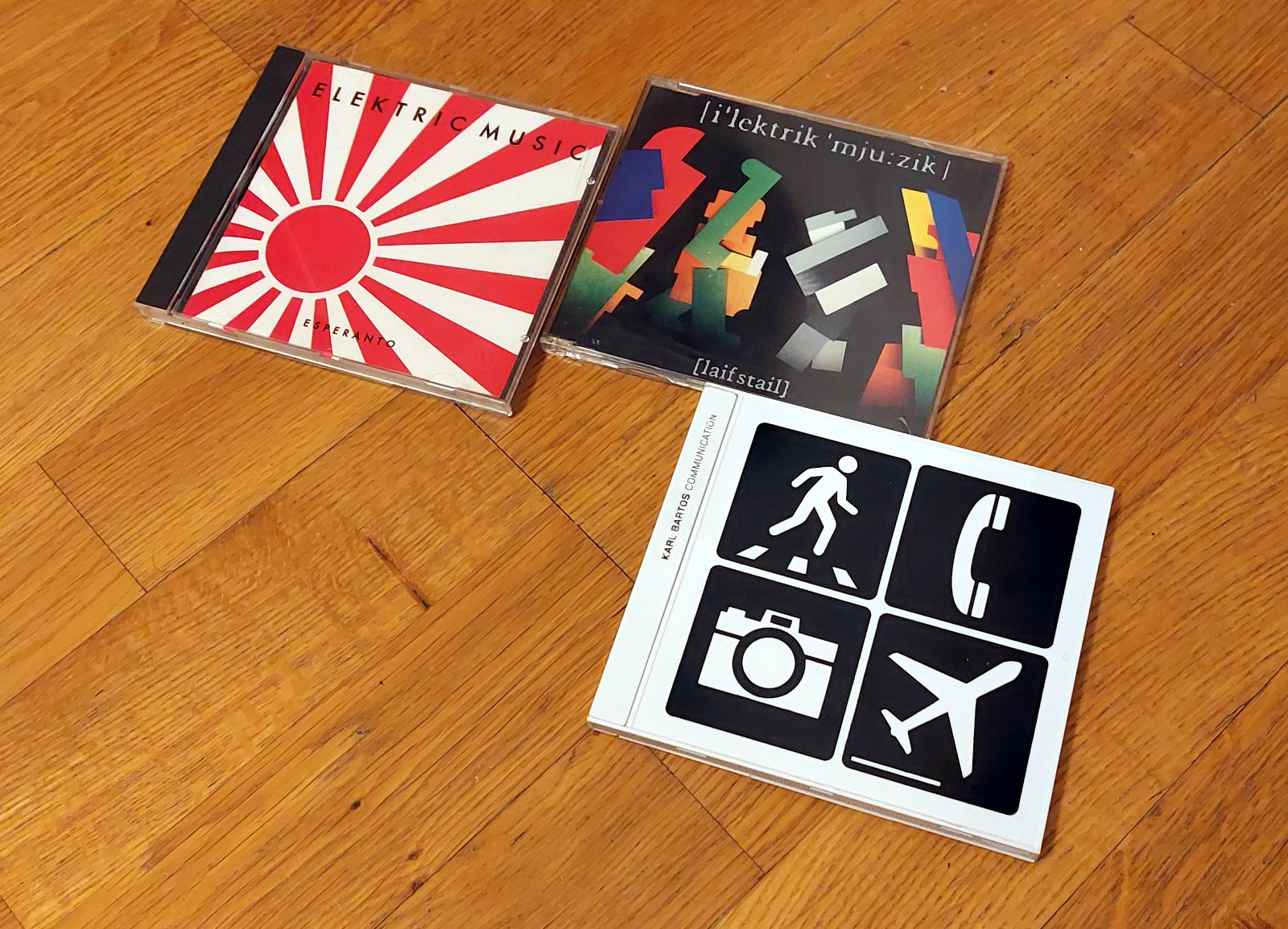
But even I was aware of Elektric Music, the project between Bartos and Lothar Manteuffel of Rheingold fame. Esperanto was a good straightforward electro-pop album in the vein of OMD and Depeche Mode, decked with a recognizable Emil Schult cover design.

Despite having material towards a second album, the project broke up. Considering how much Bartos discusses the dysfunctionalities within Kraftwerk, it's a pity the closing of this chapter is not explored in more detail.

The solo album Communication from 2003 was unfortunate in that it co-incided with Kraftwerk's Tour de France Soundtracks. Bartos laments the timing and being overshadowed by his former band. Although the album is solid, I felt it was burdened with the somewhat heavy vocoder/robot sound.

The book doesn't discuss Wolfgang Flür that much, possibly allowing his story to live in his own autobiography "I was a Robot" from 2000. In this telling it even looks like Flür didn't so much "leave" Kraftwerk, but simply did not bother to come back when his playing was required, instead preferring to focus on his interior design work. I've sometimes wondered why Bartos and Flür did not subsequently collaborate, and the book gives no answer to that.

I am slightly worried that Karl's voice in this book isn't as determined as in some of his past interviews, where he might discuss gear and events in more detail. Has he "bought" the commonly accepted narrative about Kraftwerk, and fills the gaps of his memory and notes with it? How reliable is this narrator?

Much like that Wolfgang Flür outing, this book gives just one piece of a larger puzzle. Anyone interested in Kraftwerk needs to read it. But the ultimate mystery of Kraftwerk, if there really is one, does not become really closer to being revealed. Ralf Hütter's public utterings are repetitions of past and mostly intentional riddles anyway, Florian Schneider is dead and can no longer answer questions. Possibly the long-time collaborating sound engineers, touring currently, could add their say.

For a few years, Kraftwerk had a playing field largely to themselves, but as others caught up, many of their ideas could be replicated with world-class engineering and equipment the band themselves lacked. Kraftwerk tried to rise to defend the small hill they so far had occupied, but, the way Bartos sees it, were mistaken about their goals and purpose.

Now Karl is critical of the latest trends in music distribution, which can be difficult for a musician with a 1970s conception of the recording industry. If music becomes ubiquitous, he argues, it is in danger of losing meaning. Such is the price of democratizing the means of sound generation, distribution and listening! Karl's love of music is tied forever to the moment when a person came from over the channel and put a physical disc of Beatles' Hard Day's Night on the turntable.


Off the Record, on record

I also acquired the Karl Bartos album Off the Record, from 2013. Back then I felt no great compulsion to buy the album. After reading the book I had a bigger motive, trying to see the album as a complementary piece to the retrospective writing.

As a tiny tribute to his thinking, I chose to play the disc from start to finish on a CD player, instead of habitually ripping the tracks over to the computer.

The album plays heavily into the idea of Bartos as a former Kraftwerker, an identity he has variously distanced himself from. The backstory of a "secret audio diary" gives the tantalizing prospect that here might be some material from the golden age of Kraftwerk. Yet these are no lost tapes, but new songs based on concepts and material from over the years, an "autobiography in sound".

Glancing at some reviews and comments, some apparently feel Karl's solo output sounds the same as Kraftwerk. I tend to disagree. Although there are Kraftwerk quotes here, to me this is still an extension of the personal sound Bartos developed after leaving the band. 

Yes, it's surely part of the same genealogy and almost immune to any recent trends in the myriads of genres of electronic pop music. Nowadays the idea of equating progress with electronic music appears problematic, so it is not surprising the album does not attempt to innovate but to simply move on.

I felt that listening to the record as a whole makes the music stronger than trying to concentrate on the merits of any individual songs. The more beautiful and intriguing spots are distributed evenly across the album, no one song becomes a real stand-out piece.

Beatles was a revelation to Bartos. To me Kraftwerk was perhaps a similar turning point, something that made me appreciate any music at all, really. But it may be that instead of music, to me computers and TV games were more miraculous and a "lights-on" moment, the "voice of my generation". Encountering Kraftwerk's music and visuals was more an expansion of that experience.

Thursday, 3 February 2022

Ball: The System


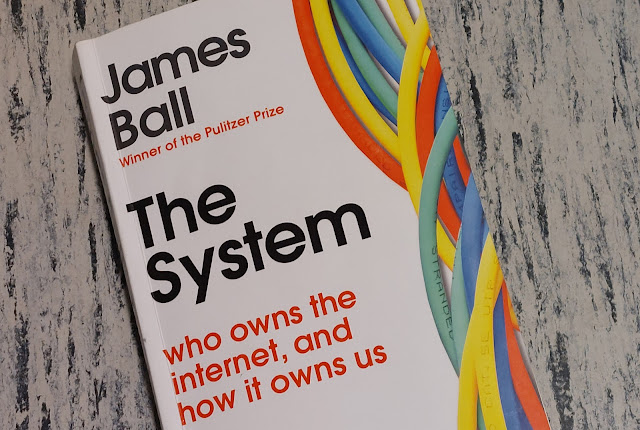
I read the 2020 book The System. Who owns the internet, and how it owns us from James Ball.

Instead of explaining the technical workings of the internet deeply, or dwelling too much on the invention of computer networks, Ball instead presents a loosely chronological cross-section of the forces that, in different times, molded the internet as we know it.

The focus is in the who owns the internet, and how it owns us part, identifying challenges in various areas regarding loss of privacy, concentration of wealth, aggressive advertising, eradication of journalistic quality, threats to net neutrality...

I'm making shortcuts by not addressing the origins of these varying opinions, and for most part simply go with "Ball says", the author being responsible for the book as the curator and presenter of these viewpoints.

The story so far

Ball figures the early era (about 30 years) was when most of the decisive technologies and protocols were set, but were in no way envisioned for a multi-billion user, global internet. The stage is set for an environment that is used by large masses of people, having implications for ethics and security both in national and global scale.

With the invention of the World Wide Web the commercialization of internet began in earnest, leading towards the original dotcom boom and crash. Venture capitalist funding has served as the driving force of the internet for the past 20 years. Seeking to make ever larger profits through new companies, the bigger companies then foster a new generation of influential startups. The new smaller companies will be hungry to demonstrate their viability for the next round of funding.

Pretty much the only thing that can be monetized is a large user base and increasing it, this is what they will try to gather, at first providing benefits "for free" to the users. This has had also social and political consequences that took the company founders by surprise. Whereas there are good grounds for claiming the internet network itself is a neutral utility, sometimes the providers of the "platform internet", such as Facebook, have argued similarly when their service has helped sway public opinion for the worse.

The internet never was the same as WWW, but arguably it's the surface layer of things that make it a force for people. But even the "WWW era" may eventually be a thing in the past, as smartphone app ecosystems have proven. Regulatory approaches lag behind, and may not even always touch what is happening in the ever-changing app world. Movements are born in channels like Facebook, Youtube, Twitter, Twitch and so on. The mobile phones are loaded with apps and services that utilize the internet connection in different ways. In some countries, the ISPs don't sell so much "internet" but "facebook".

The book sheds light into the complex way ads developed over the internet, from modest contextual banner-ads to the programmatic, then the targeted/auctioned ads of today that have helped generate an ecosystem of fake content and clickbait headlines. Some sites have begun to live an independent life from any "quality" website. Ball accuses publishers having almost willingly given away their position as a provider of lucrative ad space, whereas initiatives like the GPDR only succeed to miss the original point (of curbing the rampant ad-cookie exploitation).

Ball questions the truism that ads are needed for any free content, as internet did nicely before targeted ads. He suspects that middlemen benefit far more than the deserve, but also suggests that things wouldn't need to be as bad as it is. Ads can actually serve a purpose, but something about the system needs to be better tuned to avoid the worse excesses.

The recurring triad of evil here is Silicon Valley-style Big Tech (make things fast and fix them later), Free-market economic theory derived from Reagan/Thatcher era (what makes wealth is also morally validated) glued together with Venture Capitalism. (fund a promise of future profit despite current viability)

A new global war

The story shifts to cyber attacks, security, surveillance and the Snowden revelations on NSA, a story which Ball had a direct involvement with. Just to recap, NSA experimented with a system that would store "everything" in UK communications for three days, and the metadata for 30 days, something that was technically kind of legal there. Furthermore, NSA had actively sought deals with companies and online service providers to build backdoors in them. From some kind of niche occurrence, hacking has turned into a constant cyber war being waged between governments.

All this wasn't achieved by intelligence agencies alone, nor was it devised by governments as some kind of intentional conspiracy. Ball argues that the aforementioned advertisement capitalism led to a situation where massive pools of user data were suddenly available on the internet, given away willingly (or at least without worry) and eventually worth experimenting with.

Platforms such as Facebook are here seen as an extension of US "soft power" abroad, hence the US might not have been that eager to regulate tech companies and their platforms in the first place. The apparently altruistic push to bring internet to less developed countries can be seen as building US beach-heads for favoring their established companies. So, it's not simply a language barrier and a dictatorial regime that makes countries like China and Russia build their own version of the platform-internet.

It's also an issue who will host the new version of the internet's surface layer in the future and what it will be like. The danger of 5G is not some skull-eating radiation, but that with the new standards there's an opportunity to smuggle in ideas about network "slicing" that again may undermine net neutrality, become a new kind of surveillance tool, or another "soft power" extension of some nation, this time perhaps China. When Huawei was stopped, it was largely on suspicions for the kinds of things US had already previously practiced when holding the strings of the internet.

A couple of times the book draws parallels between internet and the original railroad expansion, acknowledging the main difference that railways tended to centralize and internet is inherently dispersed. But what is being centralized is the wealth in the hands of those who were already well-to-do before internet existed, much like what happened with the railroad.

Whereas industry giants could benefit and leverage the railroad network to gain advantages in other fields, the 20th century anti-trust activities largely put this to an end. Mergers are still scrutinized, yet when something similar happens on the internet, it's not an issue, as Ball repeatedly points out. The Facebook acquisition of WhatsApp is especially lambasted here, but companies like Google(Alphabet) and Amazon likewise made strings of acquisitions without being questioned.


Uh, huh

So, all in all a very light read, but not altogether "light" in the themes it presents. The angle is journalistic rather than academic, giving it more dramatic tension throughout, perhaps even an agenda. The quotes from the interviewed people speak a story, and the reader can make their mind about them.

Still, the discussions and opinions are from noted authorities (including academics) so their voice does have weight. There is a value of having a book like this on your lap while things are still happening, rather than having the academic account ten years later.

I'm not sure what to make of all the pessimism. On one hand the book is attempting to shake people out of the kind of "Yeah it's bad but what are you gonna do" mentality, on the other hand it does paint a picture of a very major complex that can barely be touched by individuals.

The suggested remedies in the book are intentionally somewhat anti-climactic. The whole message of the book is that the internet has a number of different problems in it, and therefore there is no one major fix. Advances can and should be made in multiple smaller areas. At best it is possible to encourage a "systemic" view into the complexity that is the internet and to remind it's the people that set it up and formed it in the first place, not some force forever outside our reach.

Sunday, 18 October 2020

Book: Tom Lean: Electronic Dreams


I recently skimmed through bunch of early 1980s ZX Spectrum magazines from the archives. The period seemed markedly different from the later games-oriented 1980s culture, so I wondered if there was literature about it. Turns out there is a British book about the home computer boom in the early days, called Eletronic Dreams: How 1980s Britain learned to love the computer (Bloomsbury Sigma, 2016)

The book was exactly spot on for me, as it does make notes on the early computer press in UK, even before the Spectrum days. It also provides some insight into the national zeitgeist and political background that the reading of early Spectrum magazines hinted at, but would not explain. 

The magazines really took upon themselves to educate people about computing and its uses, as a preparatory step to the future. Where and why did such a national fervour originate?

This is less a review of the book and perhaps more about the thoughts it inspired.

The book is prefaced by a concise history of the development of the computer and explaining the distinction between an eletronically-stored program computer with its predecessors. The emphasis on the UK and also the hobbyist angle in US and UK. There is a strong reminder that the UK had the lead on computer technology in various times and sported many "firsts", but lacked resources to keep ahead.

As the heavy industry was on the brink of collapsing, computers looked like a way into renewing the country, and for a short while the bespectacled teens from the suburbs of abandoned steel mill towns became the unlikely icons of this new opportunity.


Here comes the Sinclair

The significance of the low cost of Sinclair's ZX81 is greatly emphasised. Although the Apple II was a complete system for home, it was an import and the price was still prohibitive for an everyman. Magazines like PCW listed various computers systems for the UK market in late 1970s, but often with prices in excess of 2000 pounds.

It is now often too easy to look at just the specs of the old computers and put them into a top 10 list or something. It was the cheap price, marketing, penetration to the high street stores and a national rhetoric that drew ordinary people to buy a computer, not the specifications per se. ZX81 opened the gates for this.

The BBC computers are fairly unknown in Finland, so the story was less familiar to me, although I've known it in connection with Sinclair. As a kid I took it granted that computers came out of UK, but in hindsight it is a bit surprising it would be such a hotspot for the micro era. The Ferranti ULA chip appears to have been a great enabler there.

As an aside, BBC was one of the few 8-bit micros that were made with computing speed in mind. General users did not really discuss processing speed, and had it become a criteria more people might have wanted the Beeb. Look at BBC's Elite to see how it was meant to be. The structured BASIC is indeed pretty fast. Sinclair QL's SuperBASIC, although powerful, was jaw-droppingly slow in comparison. 

Even if most of buyers just dumped their cheap computers after the novelty wore off, the huge numbers and the timing meant a movement, or a cultural wave had been generated. Perhaps this Bit-lemania did not result in a Bit-ish Invasion, but nevertheless it had become something widely known and commented on. 

Although in Finland the Commodore 64 is now recognized as a 1980s cultural artifact of some importance, its reception at the time still pales in comparison to how the Brits loved their Speccies back in the day.

In this telling, Sinclair appears to have been less antagonistic towards games than some narratives have suggested. Spectrum was already designed with games in mind. And it's obvious from the early lineup that included polished games such as Flight Simulation and Chequered Flag, not to speak of Chess, Othello and Backgammon. All of these were relatively high-brow and "educational" and the Spectrum still did not come with a joystick port.

I'm thinking if the Spectrum was nothing more than a packaging of the features the 3rd parties offered for the ZX81: extra memory, better keyboard, pixel graphics. Even the simplest analysis for the uses of ZX81 would reveal that games were popular.

Still, the book maintains the high proportion of games and the whole gaming culture that emerged, came as something of a surprise.


All you need is 1K

The resounding question was "what is it for?" It is repeatedly pointed out that home computers were pushed onto the market without a clear concept what the home needed them for. 

The book strongly points out the educational and computer literacy project was consciously kickstarted in the UK, and this engaged both public imagination and suggested opportunities for private sector.

And it turns out the early 1980s reason truly was "programming", not recipes or games. Therefore the answer the author presents is actually quite clear: From a political and social perspective, home micros were a literacy and educational project, a head start towards things to come.

As much as no one figured you should really type on the computer, it becomes understandable many cheap computers did not have advanced keyboards. If you were expected to write a BASIC program that tops at 1K, you could write it on any moldy log.

The book gives a convincing case of the home micro era as a short exploratory period where the purpose of computing of home was being teased out, paving way for the more task-oriented workstations, "personal computers". Just about then the persistent killer applications for home turned out to be word processing, and in hindsight, spreadsheets, for which the 8-bit micros were somewhat inadequate.

Against this backdrop it is not so surprising that Sinclair would attempt something of a "home business" computer with the QL. As the micros were on the way out something new was needed. Rather than being ignorant of what was happening, Sinclair was simply looking at what the existing uses pointed at, followed his previous formula, placed his bets and lost.

The book is also an important reminder that the rhetoric that pushes "coding" for young people, already existed in the 1970s UK if not earlier. "If you don't teach your kids programming, they will be the losers in the future. If the nation doesn't upgrade itself, it will be a loser among nations."

The author ends the telling with the 2010s perspective, when the "new BBC micro", the Raspberry Pi became a hit. And it's true there is a certain amount of industry and new learning that has spawned around platforms like the Pi and (unmentioned) Arduino. The emphasis is more on learning digital electronics and embedded systems, but it's also possible the Pi is devolving into a cheap "2nd desk computer".

I'm rather wondering if 2010s smartphones and tablets should also be compared with the original home micro boom. At first, many companies rush to the market with devices with poor ecosystems and few standards, producing an industry of gadgets and fixes to problems that might not even exist. A few random people become rich by creating software and games for the new environment, before big business and the logic of the marketplace makes it impossible but for the most dedicated teams. 

Let it Bit

The home micro era was a roughly 5-year period of time sandwiched between the professional, industrial and scientific computers of the 1970s and the personal computer era heralded by 16-bits like the Macintosh, Archimedes, Amiga and the Atari ST.

Whereas the home micros period was marked by self-programming, exploration and learning, the new personal computers were based on launching ready-made applications, with already identified tasks such as word processing and games driving the design.

Although the home micro "paradigm" wasn't sustainable, it had certain important repercussions. As an immediate result Amstrad managed to extend the life of the micro by bundling it anew and also had success at packaging the PC for Europeans. People at Acorn pioneered the ARM processor. The UK games industry was born out of the home micro era. 

To me, Electronic Dreams has an additional subtext. Here newspaper snippets, hobbyist magazines and television programs from an era are used to create the picture of the public reception of the computer.

At the same time these were the medias most people still got their information from in the 1980s. Even the UK had only three TV channels and the BBC shows about chips and computers were seen and discussed by huge number of people.

The depicted age is therefore doubly nostalgic. Now all possible binaries, experiences and facts about old home micros are retrospectively regurgitated on the internet (ahem), but part of the charm is the relative isolation of the 1980s computer hobby and the openings into a wider world that the magazines, clubs, books and the occasional TV program would puncture. 

The book does go through quite a lot of widely known things and anecdotes, which can put off a reader who has already read many computer histories. Yet the landscape painted using these smaller stories is not yet too often seen, and the attempt at somewhat wider picture is very welcome.

Tiny mistakes are unavoidable. The QL did not have a 256-color palette initially (but 8) and the multitasking had to wait a bit too.

The book strikes a balance between a more general history of computing and the often too narrowly focused books that celebrate a single computer platform.  It is an unashamedly British-centric book, a  slice of history from a time and place when the notion of a "home computer" was still exciting and about the future.

Thursday, 27 August 2020

Book: The Future was Here

I finally managed to read Jimmy Maher's The Future was Here from 2012.

Before the Amiga 500 models hit shelves, Amiga really had a rather vague existence somewhere at the horizon of my experience. One of those computers that might be cool but would never ever be relevant to me, perhaps even a bit boring. The comparatively high-brow images of Botticelli's Venus and even the King Tut image were not very alluring to a 10-year old.
Probably my first impression of an Amiga, MikroBITTI magazine 9/1986. Bleurgh boring adult computer.
It's fascinating to read about the birth of the Amiga and the early handling of the platform by Commodore. When I finally saw an Amiga at the end of 1980s, things like the boing! demo were already ancient history and not that well known to a casual newbie like me in Europe.

I was also surprised to learn that the Commodore-bashing from Amiga owners did not start in the 1990s, but was almost inherent to the platform from the very beginning, including the logo debacle and poor marketing.

As the book points out, the North American Amiga experience was quite different to the European game- and demo-oriented culture, and the two overlapped very little. In the US, computer industry stalwarts, Unix alumni, scientists, professional artists, Fred Fish, adult people, flocked around the platform in the mid-1980s, eager for a revolution that seemed just around the corner, but also abandoning the platform at a point when it looked the promises failed to materialize.

Sorry it's a bit flat.
I hadn't figured the boing! and Juggler demos had such a large impact on the audiences at the time. The bouncing ball was even more "fake" than I had presumed, not a single pixel is drawn during the animation.

Maher suspects part of the reputation here was that people thought it did something it really didn't. He further points out the value of the demo is in the ingenuity of making the computer do what it was good at doing.

Today it might make a quirky, endearing GIF.
Juggler demo was more transparent in what it did, because obviously the Amiga could not do real-time ray-tracing. But that the animation frames were produced on an Amiga at all, was already a huge achievement and paved way for a kind of cottage industry of 3D and ray-tracing applications. The use of the 4096-color HAM mode and animation itself proved inspiring, regardless of the raytracing.

The portion opening up the Juggler and boing! was an insightful read and I hadn't really understood their appeal in these terms.

Although the author doesn't say it directly, one possible reason why early Amiga demoscene demos had lot of spheres and checkerboard patterns, could be because of these two "industry" demos.

Vectorballs from Dual Crew, 1990.
They might also be quite obvious choices. You need a very generic small, simple object that can move anywhere? It's a ball. What's a non-expensive yet somewhat complex background that works well to bitmap graphics? A checkerboard.

In any case, the Juggler was sometimes explicitly referred in early scene demos, such as in the Vectorballs demo from Dual Crew (and the Red Sector Megademo and the Cebit'90 demo and others.)


The Heyday

The paint program Deluxe Paint enjoyed a kind of "killer app" status, and the Amiga was long bundled with a version of DP. The author makes a neat analogy that Macpaint was a drawing program whereas Deluxe Paint was a painting program, demonstrating that a line can be drawn (cough) from the platform characteristics and the respective company cultures to the final product.

Yes, as a "platform study" book the author shows routes from Amiga's hardware design decisions to the software and use cases. The object under study is best understood as "emergent". Software such as Deluxe Paint or Sculpt-3D is not a determinist result of the platform's technical features, but part of a kind of sub-cultural wave that grows layer upon layer on that initial technical seed.

Deluxe Paint III
The platform's journey has early software milestones such as the boing! and Juggler Demo, but the culture of Commodore and essentially its "fanboys" will carry it onwards. Deluxe Paint and Protracker were in turn hugely important for the game- and demoscene culture that came after.

Amiga's important niche as a video authoring tool is also examined. This was also something very much in the far periphery for me back in the day. NewTek's Video Toaster was more of a new computer on top of Amiga than just an add-on. Its achievements barely fall into Amiga's basket, unless taking into account the aforementioned view of a 'cultural wave' emerging from and surrounding the Amiga.

Looking the Amiga's role in semi-professional and even professional video editing circles, Amiga's significance in this area is very much tied to the analog video era, very different from 2020s internet digital video ubiquity. The flickering interlaced high resolution output was a bane for traditional computer users but a boon within the video circles. The value of genloc, the logical mixing of computer image with input video, could also be puzzling unless factoring in the reigning analog video format.

Protracker 2.3D. Ok, this is a clone version.
The Amiga demoscene gets a looksie, using TRSI's Megademo and Spaceballs' State of the Art as opposing poles to represent the scene's technical achievement on one hand and dedicated audiovisual tinkering on the other. The standard story of the scene emerging from crack intros is told. The outcome (echoing one Viznut!) is that the scene should be examined in its own rather than shoehorning it into pre-existing categories of 'free software hackerism', 'art' or 'youth subculture', despite having some characteristics of all these.

Discussing games, the author takes an interesting standpoint that Amiga could be seen as a forerunner of today's casual games, citing Defender of the Crown and Lemmings as prime examples. Amiga is also a platform where a visually story-heavy game started to come into its own, in contrast to earlier video games that were more reaction- and rule-oriented.


The End

The author generally balances praise with critical tones. But perhaps the one area where Amiga's myth is more openly torn apart, is the multitasking operating system. Although Amiga's OS and the Workbench were landmark systems, there was also a crucial lack of memory management and the experience was hardly as friendly as the surface made it appear to be.

Workbench often needed the kind of tinkering that user of a simpler Mac or ST might never need to see. Also, some of the Amiga's innovative features would not survive a second in our security-obsessed world.

Maher argues that at least part of Amiga's downfall was hard-coded into its, despite all, somewhat shortsighted and complex design. The inventive approach that combined cheap parts for vastly more than the sum of those parts in 1985, was not as conducive to upgrading as were the more straightforward IBM PC clone components.

I'd still like to think that none of the 1980s home computers really got proper upgrades, and in this race Amiga fared a bit better than most.

Overall, Maher's Future Was Here gives a convincing case that Amiga was the first true multimedia computer, a forerunner for many desktop computer use trends that are now incredibly commonplace: creation and distribution of music, images, animations, demos, photographs, videos and much more.

To point out Amiga was not a harbinger of the mobile internet cultures of today is to miss the point. Sharing and consuming of Amiga-originated creations might have happened in the loosely-knit network of Bulletin Board Systems or the even slower network of mailed physical floppy disks. But shared they would be. Criticism and response could likewise be found in the diskmags and scrolltexts of the era.

The "I'll show mine" attitude prevalent in today's internet is already very much in evidence in the Amiga subcultures. These days, one's exploration of a musician- or visual artistship may just as well begin on a computer as on a so-called traditional medium. Amiga was the first computer to make that genuinely possible.

Friday, 31 July 2020

Book: Kraftwerk: Future Music from Germany

Kraftwerk: Future Music from Germany, by Uwe Schütte, 2020, is another 'introductory' book to Kraftwerk. I recall when Pascal Bussy's Man, Machine and Music from 1993 was pretty much the only book on the topic. Now it seems there's nearly an industry making stories out of Kraftwerk and the krautrock phenomenom.


Not that I complain. It does make an interesting read and is still a little known story. Kraftwerk are known for a certain elusiveness, which further separated them from the usually rather pushy pop-acts. Therefore the fans are even more hungry for any potential new snippet or insightful interpretation.

The book traces the evolution of Kraftwerk from a local art-scene band to an internationally known electro-act. The book structure is firmly mapped over the album releases, and it's not a long nor a very detailed book. If you read the ANTENNA mailing list actively in the early 2000s, there's probably not much new in this book, despite the 2020 perspective. In some of the details, the book does read like a compendium of the collective insight in that group.

Perhaps following these times, there's more need to re-examine the band's strategy of flirting with fascism, and to discuss racial themes in relation to the band. Despite some early bad international publicity and poorly calculated attempts at playing a game of stereotypes with journalists, it's long established Kraftwerk do not condone nazism. But, despite that, now the somewhat flippant notions of 'ethnic music from Ruhr area', 'industrial folk music' and the band's apparent celebration of western technological values (irony and all) need some re-evaluation too.

However, the way I read the book, the widespread appeal of Kraftwerk's music in different localities seems to testify in favour of a fundamentally anti-nationalist standpoint. Whereas rock/blues was appropriated to be the standard western white (male) music, Kraftwerk could help invent pop music that was a sufficiently blank slate, music for people who 'came from nowhere'.

Between the lines, I'm thinking the author says that Kraftwerk's asexual, 'anti-male' approach kind of rescues Kraftwerk from the sins of rock artists' maledom, despite being something of a boys' club music. The book does not do much to open the sexism of The Model, though. Is it somehow saved by a layer of irony or not, I'm wondering?

Instead the author offhandedly says the Sex Object is an oddity, and, in my opinion, misinterprets the song. It is perhaps time to say The Model is the odd one out in Kraftwerk canon, and the author is already giving tools to decipher the song this way. At least I've felt that Sex Object is now a more a song for our times than The Model.

Interestingly, the author points out the cultural stream of 1970s afro-futurism, which means that in likelihood the electro-influences in hip-hop would have emerged even without Kraftwerk, or the very least it was already a fertile ground for Kraftwerk's 'mothership' to land on.

This is a nice touch in a book that otherwise tends to follow the hype and elevate Kraftwerk as the single most important band of the 20th century. Yet, when enthusing about who Kraftwerk influenced, authors rarely discuss who influenced them. Sadly the book stops short of doing that, giving an impression that Kraftwerk transposed high art ideas of Warhol, Beuys, Gilbert&George and Stockhausen directly into pop music. To balance this out somehow the author points out Kraftwerk were not past 'copy-pasting' sound and melodic elements themselves, but this is more of a detail rather than a major reveal about the origins of Kraftwerk's sound.

It seems to me there is a route from early synthesizer music, such as Wendy Carlos' work made famous through Kubrick's Clockwork Orange. Especially the march, with overlaid vocoder singing works almost as a blueprint for Kraftwerk's Trans Europe Express -era music. I recall Pascal Bussy had this in mind with his earlier book, rightly tracing the emergence of Kraftwerk as a result of the evolution of the synthesizer, making notes of the moog music era and novelty songs en route to Kraftwerk.

I recall fans have sometimes suggested that Kraftwerk brought the funk-like elements for their music from, well, funk. I've not yet found the famous Numbers beat from funk music, but that may be because I'm not an aficionado. Captain Sky might be a starting point here. I believe Kraftwerk were actively mining any new music styles behind the Atlantic ocean, especially after visiting US themselves. Was Kraftwerk simply one more band to take elements from world music, but just being more clever and more tactful about it? Even if the beats might owe something to funk I guess the insistently monotonic and minimalized beat in Numbers is really their invention.

The book repeats the fan-historic and journalistic consensus that Electric Café was a misfire and does not belong to the canon of great Kraftwerk albums. I always disagree. Perhaps I should argue this in more detail some day!

Let's say I really suspect the criticism always came from older Kraftwerk fans, those who started with Autobahn and saw the band further themselves from that sound and conceptual point of origin. But I think for us, the Commodore 64 generation and 1990s techno musicians, it was a very important record, and working backwards towards Autobahn and the older records was always a bit of a challenge.


What I find most valuable in the book is the way it connects Kraftwerk's themes and concepts with locally german cultural and political events, such as the debate on nuclear power and the terrorist scare of 1970s-1980s. This nicely ties with the central idea that Kraftwerk was a project of building a new European and German identity into the void after World War II. But I think Pascal Bussy already suggested as much.

There could have been more discussion on musical connections, because as I already opined Kraftwerk did not simply filter high-art and political-societal concepts into music in an isolated bubble. Saying Trans Europe Express contradicted punk in late 1970s, does not say much because a whole futurist-disco theme existed in parallel to punk. Is Kraftwerk to thank for that too, or did Kraftwerk derive from it?

It is also sobering to point out that although the band was known early on in Germany, it was not particularly revered there during the time they were already internationally famous.

All in all, a very entertaining and inspiring read. Still I cannot help but point out some tiny mistakes and what I felt were omissions.

No, Afrika Bambaataa did not sample Numbers or Trans Europe Express for Planet Rock. Many journalists and writers tend to get the story somehow wrong. The beat was recreated on a drum machine, and a TEE-like melody was overlaid on it, creating a kind of a mash-up without actually doing a mash-up. I guess that because of the way music copyright worked at that time, only the melody from TEE became a point of contention and later pressings of Planet Rock credited the songwriters.

The computer on cover of Computer World has been identified and it is a terminal rather than a 'computer'. Interesting detail here is that supposedly the band had this particular item, and it was used for working on speech synthesis.

Schütte bluntly says that first home computers arrived after the album Computer World (1981), stating that the Commodore 64 from 1982 was the first 'true home computer'. No, Apple II was available from 1977. Commodore's PET (1977) models likewise predate the album. Atari 400/800 were also from 1979. Even in Europe, Sinclair ZX80 hit the shelves in 1980.

It is true the home computer 'fad' properly reached Europe only later and in a sense Kraftwerk had hit on a fashionable concept early on, possibly by having a whiff of what was already happening in the US.

Digressing a bit, I've never felt the rather excellent album was particularly 'prophetic' (an adjective often associated with it). I'd say it was observative about things that were already going on. Computers had permeated trade, banking and logistics already at that point. This would be especially true of highly industrialized centres in the USA, Japan and Germany. It's just that computers had not yet entered home life to the extent we now know.

So, to me it would be better to say that with Computer World, Kraftwerk managed to identify concepts that had real staying power.

Yes, Rebecca Allen (not 'Allan') set up the computer graphics for Electric Café album and the video Musique Non Stop. But it was not a new invention, it was basically re-use of the techniques that had been used for the film Futureworld (1976), and partly showcased in Allen's earlier contribution to the Adventures in Success music video project from 1983. The technique dates back to early 1970s and research into computer graphics at the University of Utah. Of course, stylistically and artistically the bold Kraftwerk rendition is the most impressive. But purely from a technical viewpoint it was hardly state-of-the-art anymore.

When it comes to The Mix, to me it seems an omission not to say that the album could be considered Kraftwerk's idea of a 'live' album, in that the songs now resembled what they sounded in concerts.

Despite mentioning the new concerts, the author does not mention Kraftwerk gave album-themed concerts, and generally being more flexible as to what songs to include in a concert. This meant a sudden influx of revamped songs that were never before played live. To me this is the most significant, last step in the Kraftwerk archival process, and perhaps not so much the 3-D visuals and sound.

I don't get what the author has against Daft Punk.

Thursday, 27 September 2018

Recent sci-fi reads and re-reads


Out of the blue, some sci-fi books I've read during the past year or so. It turns out I've missed quite a many classic works.


Fred Hoyle & John Elliot: A is for Andromeda (1962)

An adaptation of a now-extinct TV-series. Aliens send a coded message on how to build a supercomputer, which in turn helps build a biological entity, which in turn helps build a more complex, human-looking entity. Possibly an early example of this concept. No crossing the light speed barrier here!

Written at a time when sci-fi writers could fantasize about telepathic powers, transhumanist themes and super alien beings, but didn't know what it would mean to have a really powerful computer. Still, Hoyle is quite clever in proposing a vast 3D-matrix of connections that begins to resemble the neural activity of a brain.

There's also TV-like suspense and silly gender roles. The idea of a beautiful woman as an alien emissary does not quite scan the same way in a book as it does in a visual medium, it's an old-fashioned trope too.


Orson Scott Card: Ender's Game (1985)

After Dune, this was perhaps the most major and widely known sci-fi I still hadn't read. (Currently, this distinction is perhaps held by Larry Niven's Ringworld or Frederik Pohl's Gateway)

Children are reared and conscripted for a hypothetical war fought somewhere in faraway space, against an alien race that has only ever appeared once before. Most of the book-time is occupied with the kids' training, as they engage with zero-gravity sports with ever intensifying and more unfair rules, with some computer hacking and VR-like video games on the side.

As the novel was written in the 1980s the tech is fairly well projected. The turf wars and underlying brutality (and humanity) of children let loose at each other is rather nicely written. The twist ending was a bit guessable, which by no means takes away the impact of it.


Orson Scott Card: The Speaker for the Dead (1986)

The sequel to the Ender's Game continues with pacifist themes. Although a good read, somehow it's not quite as satisfying. The mystery of the ever-so-alien aliens serves as an allegory for the engagement with "other" cultures, a common theme in more anthropological sci-fi.


Joanna Russ: Picnic on Paradise (1968)

One of my re-reads, a short novel I recall I didn't particularly like when I read it as a teenager. Due to an outbreak of war, the tourist planet of Paradise suddenly becomes a very dangerous place. A time-agent is tasked with escorting a traveling rag-tag group to safety, a diverse bunch of tourists mostly unsuited for roughing it.

Here the main story is in the discord between the time-agent, who originates from ancient Earth times, and the people with future social mores, an extrapolation of our own times. Although surely a step forward for feminist sci-fi/fantasy, the heroine is perhaps no longer so unconventional. Yet what remains is still a sense of real physicality of the journey and the "dread from above".


Alfred Bester: The Demolished Man (1952)

Alfred Bester was quite unknown to me, despite being one of sci-fi cornerstones. All the ESP/Psi-themes ever written owe something to Bester (The TV Series Babylon 5 named a character after him). Notably Philip K. Dick's scenario of a future ESP squad in UBIK is very close to Bester's world.

Here the plot revolves around whether and how one could get away with murder in a telepathically equipped society. Turns out you need at least an earworm.


Alfred Bester: The Stars My Destination (1957)

Humankind finds out teleportation is a possibility through willpower alone, but not everyone can do it and not everyone can do it extremely well. The repercussions of this for society are explored in somewhat same vein as the telepathy in the Demolished Man. The gap between haves and not-haves has risen, and corporations run rampant. Nascent cyberpunk themes. Also, drug and body implant-induced bullet time, anyone?

Although I perhaps liked the telepath-society of the Demolished Man better, the narrative drive is stronger here. I'm not a fan of "experimental writing" in sci-fi, it feels like an experiment on experiment, but I'll give it a pass here.


John Brunner: The Shockwave Rider (1975)

Supposedly a proto-cyberpunk novel that influenced Gibson and the like. Phone-hacking and the word "worm" for a computer virus is famously found here.

Some of the themes were interesting and indeed before their time, but the writing quality was not that appealing to me, filled with puns and telegraphed short chapters. There's a lot of pondering about an ideal society, voiced by the main characters, handily with no one around to critique them. At the end we meet a kind of hippie community which further dates the views presented in the book. There's a trace of the hacker ethos here too.

This book is hugely influenced by Alvin Toffler's almost-fiction The Future Shock (1970). One of Toffler's scenarios was that as the pace of life increases, we might go through various "lives" inside one lifetime. Here the main character goes through various different personas and identities given flesh and bone, by the telephone. Lift up the receiver and I'll make you a believer.


John Haldeman: The Forever War (1974)

Comparable to Ender's Game, but perhaps less grand scale sci-fi. The grunts are taken to faraway planets to fight twitch-and-die battles, but time dilation is no joke so the vets will find their home changed a bit after a campaign. Maybe better re-enlist. Before you even get to say "Vietnam-allegory!", I'd say the story works as a stand-in for any war, and this if anything helps make the book enduring.

The term "laser squad" comes up, and indeed while reading I felt this might have influenced the Rebelstar Raiders, Laser Squad and UFO/X-Com games.

Another book influenced by The Future Shock, Toffler even gets a name-drop. The sequence where the soldiers get back to Earth to see how everything has changed, has maybe not aged that well, but it's a necessary part of the story and the point gets across. The military sequences and the grand scale of time dilation become far more inspiring.


Ursula LeGuin: The Dispossessed: An Ambiguous Utopia (1974)

One of the books I read when much younger. The neat thing about sci-fi was I could be entertained with fantastic concepts while introduced to themes like philosophy, alternative social mores, gender equality and political systems, something that I might not have done otherwise. I guess LeGuin's grand achievement was in being able to smuggle in feminist themes to a genre read by young men :)

Two planets, Anarres and Urras, two clearly different political systems and cultures. The other is highly propertarian and capital-oriented, whereas the other has abolished property. Gee, what could it be an allegory of? LeGuin fleshes out the problems of the systems, although also siding with the more gender-equal, socialist Anarres.

For the younger me this was quite a difficult book. I'd like to now say it is a masterpiece, which it kind of is, but it isn't as light entertainment. Which is to say I admit I'm currently looking for sci-fi that has both high concept ideas but also works as stress relief and escapist literature. Or, to put it in another way, I'm currently not too keen to read about a scientist facing problems with publishing papers.

Friday, 6 November 2015

Designing the Automated Office 1984

I took some photos out of an old book, Designing the Automated Office (by Pulgram and Stonis). Mostly it's the usual early 1980s normative design guideline book with scientific-looking diagrams and measures, but it also has nostalgic photographs of cute terminals and overtly neat environments. Published in 1984, the material reeks more of late 1970s stuff, not very visionary or with the latest trends. Unix, CP/M and Xenix are the only OS mentioned, it's as if personal computer revolution had not happened at all.

Sorry for the poor quality, these are simply mobile snaps. Maybe improved later...

A company that worked on computers would probably be an early-adopter...
Not a huge expert on offices, but I've worked in some and been involved with it as a topic. Office space trends are obviously always in transition, but what's particular about this era is that the layout of the office still remains fairly traditional, yet is invaded by computer terminals and equipment. Soon after, developments in computer applications among other shifts started to erode the traditional office space layout, too.

Old CAD workstations prove that Apple didn't invent GUI. Design-metaphor ought to have become the generic GUI metaphor, and not the desktop! 
It seems to have been terminals all the way. Most of the stuff has probably been thrown into the bin since, and is not that noteworthy. The outer designs are fascinating, though, as there seems to have been broader ideas about what a computer terminal in an office ought to have looked like, before it all settled into grey rectangular boxes in the 1980s.

Another cute, if repetitive, semi sci-fi environment.
When discussing future offices, a lot of expectations are put on voice recognition (as still is) and "smart walls" with text recognition (we are still waiting). In 1984, it may not have been hard to predict that video projection would become commonplace, but they sort of missed the mark on what would be reasonable complementary technologies. I've yet to see any really sensible smart wall product for office. Possibly this is because although smart walls are feasible now, the settings in which they were envisaged for are not really there anymore.

I'm wondering if that's a microwave oven or some kind of information superhighway.

Prior to computers the office kinda was the "computer", so as computers matured the office as an environment started to become a bit redundant. There's some indication of this in the book, as portable computers and gadgets are discussed. These are a bit naive in hindsight, but what else they could have imagined?
Typing "please come in", the text would handily appear outside the door, where the client was waiting...

Saturday, 17 October 2015

A little something about Finnish computer magazine scene

MikroBITTI, the Finnish general computer magazine published from 1984 and discontinued in early 2015, has now fused with another magazine, born again with the original logo and a promise to focus on computer technology. Published monthly, the new mag concentrates on reviews and commentary of computing products, spiced with more speculative futurist articles, tutorials and opinion pieces. This is very much in line with the original magazine which inherited the review-orientation from the long-running Tekniikan Maailma ("The World of Technics").

MikroBITTI and Skrolli head-to-head. WHICH ONE WILL WIN
This is not the only new paper-based computer magazine that uses the 1980s recipe to attract new old customers. Skrolli, published from since 2013, 4 times a year, instead focuses on non-commercial, hacker, DIY, development, programming and demoscene cultures and rarely if ever includes consumer reviews. Skrolli was the first to tap into this new niche of catering for the, let's say, 40-somethings who grew up with Commodore 64, Amiga and early PCs.

It's a bit too early to compare the two magazines, as there's only one issue of the new MikroBITTI. Based on that I have to say the reborn MikroBITTI succeeds in re-orienting the magazine to a better direction, but it remains to be seen if it can be as interesting experiment as Skrolli. The reviews are surely extensive and include many devices that might otherwise be missed, now that there's an abundance of technical computer gadgets for different markets. I'm just wondering if there will be any product category left to review for the next issue! As a quarterly, Skrolli perhaps has to rely less on immediate topicality, striving towards more "deep" content on current themes.

It is arguable the new MikroBITTI has followed the example of Skrolli, but I have to say at the moment the two publications are quite different. The nostalgic logo and the graphic design were attractive enough for me to buy MikroBITTI, and I suppose many people felt the same way. The journalism, although maybe more evenly professional than in Skrolli, is also a bit generic and conventional. Although Skrolli in contrast has a more generic graphic layout, the inclusion of "amateur" images, drawings, photographs and an unapologetic use of crude screenshots helps give a friendly DIY-tone to the magazine.

Example of the stylish graphic design in the insides of the born-again MikroBITTI
Why paper now?

It's interesting that there would now be a market for paper magazines. In the UK, the number of magazines has been constantly dwindling, and only some very niche "retro" oriented publications could enter the market. Even this is already a fairly old phenomenon. Skrolli and the new MikroBITTI are not at least decidedly retro- or games-oriented. It's more like if someone in the UK thought that Your Spectrum (ca. 1984) had a great concept and ought to be seriously (and not only as a nostalgic one-off) re-wired for today's audiences.

Especially one has to wonder how some of the most techno-enthusiastic people would now clamor for an old-fashioned paper publication, even if they may have been one of the first to move away from them. (Consider disk magazines, 1990s BBS scene, internet etc.) One reason may be that there is a whole generation of computer users who grew up with magazines like BITTI and Printti, even if they may have abandoned them later. These people long lamented the lack of good computer journalism, which the 2000s magazines allegedly failed to deliver. Or I'll take that back - the old journalism wasn't that good necessarily - it's just that there was a specific mixture of elements that sort of disappeared from the market as internet began to make it unnecessary.

So there might be a market but what do they want? The cliché "audiences want well-curated content" is somewhat valid, but there's no reason why it would not work on the internet too. Yet I suppose over-abundance of daily-updated information and the effort that goes in searching the web can reduce attractiveness of specialist websites. Tired of constant feeds, audiences might want to return to the occasional bundle of information and entertainment. It is nice to browse magazines that have made choices for the reader and don't appear too often. The paper magazines may also better function as kind of banners under which the readers can show allegiance and support to a culture of computing they wish to foster.

What for?

The home computer technology has long become separated into two directions: On one hand, the earlier "pure computer" hardware, and on the other hand, all the commercial gadgets that achieve specific tasks (facebooking, messaging, camera, calendar etc). The computers in the first case are not "for" anything. Skrolli embraces this fully. Skrolli is more about the "cultures" of technology, digging the areas that commercial computer journalism and academia don't quite cover. I fondly remember the Issue 3/2014 which featured articles on Forth, Emacs, soundtrackers, fixing old pinball machines, Amiga... All simply because this is interesting now and by itself, and not just as a historical overview. An inspiring mess.

MikroBITTI seems to believe in the usefulness of the computing technology in every day life. The reviews in BITTI are a powerful means to collect at-a-glance overviews of latest computer technology that reside in the periphery of your interest, whereas Skrolli at it's best is able to probe into a rich thematic variety that inspires the reader even when the topics are not directly relevant to me. Both are fun to browse.

In any case, the paper magazine trend may turn out to be a fad only related to a particular generation of Finnish computer enthusiasts, feeding on nostalgia of something disappeared. Nerds-turned-busy dads may want their nostalgia/news arrive at their doorstep rather than spend active time to find it. Yet this generation may also prove to be a loyal customer, if the magazines can continue to deliver interesting content.

Edit: The second issue of MikroBITTI just arrived. It has roughly 50% of reviews, spearheaded by a meticulous wifi-router comparison. The appeasing of "retro" fans has ceased, no more posing with an MSX or talk about Amigas. The cover seems to have reverted a bit towards the consumer-style magazine, promising mobile phone reviews and the wifi-router article. The general interest articles are pretty nice, one about the anatomy of silicon chips, and another about the history of Finnish on-line discussion cultures. There's also a little piece about Habitat. I'd say we're still heading a pretty good direction, a bit worried the reviews take so much space.

Pathetic trolling! Everyone knows Atari ST was better.

Friday, 7 August 2015

Sinclair and the 'Sunrise' Technology


The book Sinclair and the 'sunrise' technology from 1986 is an account of Sinclair's rise and fall in the micromarkets in the 1980s. The book is written sufficiently late to include every noteworthy Sinclair project, yet early enough to be truly contemporary. (The Cambridge Z88 came later, for example.)

It is an interesting document of the struggle to acquire the money, know-how and resources that enabled the eventual production of the Sinclair home micros. I was surprised how small Sinclair's companies actually were. Clive arose from mail order analog radio equipment and amplifier business, DIY geek stuff basically. The book maintains that professional advertising and Clive's calculated presence helped nurture an image of a vastly more competent and large-scale operation than it really was.

The text is sufficiently well researched, although sometimes it seems only a few key interviewees supply the most crucial characterizations. What seemed less professional is the way the authors appear to constantly take small swipes at Sinclair. The authors are intent on showing the machines were not a result of Clive Sinclair's direct involvement, yet at the same time point out that the bad details in them (e.g. membrane keyboards) were a result of Clive's single-mindedness. This is already somewhat contradictory. Many of the products' shortcomings relate to the design insights that made the products possible in the first place.

There seems to be slight misrepresentation about the relation of design briefs, the broader conditions and constraints that inform the outcome and the "actual designing" of the technical work. This does not mean that Clive designed or invented the products - yet outcomes are a result of a broader landscape within with the engineering and industrial design choices were made. Clive's personality and business goals, for good or for worse, were instrumental in setting the engineering and design targets.

Funnily, Clive is lambasted pretty much for what Steve Jobs has been lauded for: being a shrewd, vocal and single-minded in following his visions. The difference is that from the viewpoint of big business, Steve Jobs succeeded and Clive Sinclair failed. However, as the book lays it out, it was never really Clive's fate to succeed in a big business way.

When belittling Clive's achievements, it can be asked what would have happened if Clive Sinclair had not arrived at the scene at all. Reading between the lines, the authors think it might have been better for the industry. Clive and the Sinclair brand filled a void at the time: The UK "wanted to believe" there was a new field in which the nation could excel and compete. To the authors this was largely an illusion and Sinclair's worst crime was to undermine UK investors' trust in an emerging field.

At the broadest the book is a critique of Thatcherism, using Sinclair's failure as an example of misguided policy of supporting small companies as a cure to a dwindling economy and unemployment. In fact, seeing Sinclair's career as an instrument of Thatcher's policies is the most troubling outcome of the book to this politically naive reader/speccy fanboy. However, this may also be a bias in the book. Clive's relatively small-scale dabbling in technology might also be seen as a-political.

The Sinclair products, despite their failures were quite indicative of the gadget life the 2000s would eventually become: mobile screens (the flat-screen TV), laptops (tiny computers) and electric transports/scooters (C5). However, as the landscape and infrastructure for such products did not exist, the Sinclair inventions remained rather isolated and superficial demos of what might be. Nevertheless, there still remains a certain prophetic aura about them. It's not that any one of them is particularly novel, but taken together they give an impression of some un-realized Sinclairlandia that never came to be.

As the book suggests, Amstrad is probably the real success story of British computers, but here I must also say that Amstrad is somewhat boring. Who cares about Alan Sugar? Many of the computer legends were quite unmemorable characters. I'm not saying the spectacled red-head was a great role model or a hip character. Yet he and his products brought a kind of color to the otherwise drab field. Thus, "print the legend", I say.

(Thanks to Markku for the book. Here are his views in Finnish.)

Ian Adamson and Richard Kennedy, Sinclair and the 'Sunrise' Technology. The Deconstruction of the Myth. Penguin Books.