Showing posts with label games. Show all posts

Saturday, 6 December 2025

The Invincible


This game is based on Stanislaw Lem's The Invincible, although it uses different characters and a different scenario.

Proton again offers this experience for Linux players. Surprise of surprises, it becomes choppy and slow at times, evident when I first time entered a camp. There have been claims that switching to Proton Experimental could improve things, but I saw no real difference. I downgraded a few graphics settings, which I shouldn't really need to do, but the effect mostly persisted and I just persisted with it.

What about the game? The Unreal engine visuals are nice, replete with retrofuturistic old-timey equipment, trackers, telescopes, scanners. As a member of an impromptu expedition to the planet Regis III, the player has to reconnect with the other crew and begin unraveling the mystery of what has happened.

It's immediately clear you are not a free explorer of a planetary environment. Often items tend to work only for the "event" at hand. For example, the beginning where the backpack condition and contents are meticulously inspected, suggests the backpack could be an integral part of the gameplay, but it isn't. Finding your bearings is a contained task, not something you figure through the geometry and the maps on your own.

Using the tracker

Although the tracker, scanner and telescope can be used nearly all the time, the points where they can meaningfully forward the plot, are automatically activated or otherwise made very clear.

It's of course possible there are many secret locations and easter eggs that require more creative uses of the tools, but I'll reserve this for some later time.

The Invincible is best seen as a walking simulator, a game genre which generally conflates a rigid narrative with travel. One could almost say the player character is the playhead of a narrative, but these games tend to obfuscate and produce enough choice so the player feels there's perhaps more agency than there really is.

Exploration continues...

As in Firewatch, much of the play is about moving from one place to another, while communicating with one person through radio. Similarly, you can choose what to say on occasions, but it is always uncertain whether this affects the overall narrative much.

Typical to this genre, there really aren't any complicated puzzles, so it's not like a point'n'click adventure in first person. Occasionally things and locations need to be figured out, and some tools and interfaces might prove to be tricky, but that's it. Anyway, difficult puzzles might break the story flow and trivialize the more important themes.

A vehicle is on offer too

Having read the book a few times, the secret of Regis III wasn't much of a mystery to me, but the story could still throw a few surprises. It is also interesting to see the way the game meshes with the book. Some of the story elements are almost inevitably the same as in the book, and although I didn't explore every nook and cranny, I feel some topics were also left untouched so it won't "spoil" the book.

Wednesday, 29 October 2025

Carrier Command: Gaea Mission

The knackered karrier

I once sang medium-to-high praises of the 2021 Carrier Command 2, inspired by the Amiga/ST original and released under the resurrected Microprose brand. Back then I also learned there was another Carrier Command reboot, called Carrier Command: Gaea Mission, from 2012. It was released by Bohemia Interactive, perhaps best known from the Arma series.

Gaea Mission has a bad reputation, so I avoided it for a while. Now I saw it at a reasonable price at Steam and got hold of it. 

There's a choice between Campaign and Strategy play formats, I'll concentrate on the Campaign. It looks like the Strategy game would have been more similar to the original, but after doing the Campaign I'm too tired to continue with it.

The Campaign begins with a silly Halo-esque planetfall and FPS-sequence, where you escort Essi the specialist to the abandoned enemy carrier. Compared to much earlier games such as Half-Life 2 and Halo, this sequence both looks basic and plays basic. The characters are clumsy puppet-like figures whose eyes keep wandering. Fortunately these interludes are quite short, but they also tend to appear at key story points.
"Essi, it's getting messy... haha!"

After picking up the carrier, things also pick up. The original Carrier Command paraphernalia is basically all there, but it's all far more automated.

You take the carrier from one island to another, while guiding amphibious Walrus and flying Manta-type vehicles to the command center, neutralizing the island. Winning islands increases your production network, but also adds blueprints for new equipment you can then produce.

Driving around for a while it is obvious the FPS-intro suffers from being shoehorned into a world meant for vehicle scale. Had the story started with the vehicles, the reputation might have been already much better.

As the game advances, more real time strategy elements arrive on the table. You can manage multiple units at one time. Fortunately Gaea Mission is not a Command & Conquer kind of RTS, but something surprisingly close to the 16-bit original.

Different small screens convey parallel things while on the map screen

At the beginning, the game elements are spoonfed in small quantities, and the islands involve more or less storyboarded events. You can still pick routes quite freely, and especially after acquiring the airborne Manta, it's possible to recon the island and shoot critters before invading with the Walruses.

After conquering a few islands in a tutorial spirit, the world begins to open up and you can choose where to go with your carrier, and manage the production and defenses of the different islands.

Some of the islands have different rules, and it may be impossible to invade an isle before acquiring some tech that enables entry. One island even had an absolute ban on airborne units until all air defenses had been neutralized. And I really mean absolute, the Manta will be fried when lifted up to the deck.

Driving the Walrus back to the carrier

The islands are generally attacked in the same way, break down a few sub-centers and then transfer the command center to your side. This repetitiveness is to be expected from a Carrier Command, and those who were misled into thinking this is Halo-meets-RTS, may be disappointed.

There's an abstract "barge" that delivers the goods produced on the islands. The instructor says there may be situations when it's faster to use the carrier to get the goods. This sounds strange as the carrier takes good time between islands in (supposedly) accelerated time, whereas the barge travels great distances rapidly while in real time?

A Walrus muddles through

The interface and transitions between views are very smooth on a 2020s computer, which helps make the experience bearable. Sure, the environments don't look that flashy by today's standards, and there are a bunch of tiny environmental glitches, but it ain't all bad. 

Weather and visibility change dynamically. Despite the storyboarding the islands do feel like simulated environments where tactical alternatives are also possible.

Just as in that newer game, grass and trees appear to be completely impervious to weapon fire. This is a pity, as some of the buildings and other equipment can be brought down.

The island overview from a Manta is one of the more enjoyable things

Considering this game doesn't have to carry the weight of a multi-player mode, one would expect the play to be better thought out. 

As many have pointed out, the AI, especially pathfinding, is not good. The Walrus amphibious vehicles take any excuse to get stuck and have hard time navigating bridges. The solution: Just don't use the AI expect for very obvious routes and the few parallel operations you may need.

However, even this doesn't always help. Often the best approach would be to let the Walruses sit near the enemy base entrance, and concentrate fire on the enemy. However, the non-player controlled Walruses insist on being "clever" and engage the foes. This most often results in the destruction of the Walruses as they waffle about and lose the enemy from their FOV. What could have been an M1 Tank Platoon-esque tactical triumph, is reduced to an uncontrollable, chaotic skirmish.

So far the best approach has been to take just one Manta, approach manually from the outskirts, eradicate opponents with the gun one by one, dock to repair/reload, rinse and repeat. Occasionally the ridiculously maneuverable carrier can be taken to vicinity and the opponents may be blasted with the deck guns.

Sometimes the Manta can be used to observe whether the deck gun bolts hit their targets. If not, adjust a little, fire the gun again and quickly switch to Manta view. Nice.

The carrier interior has quite a lot of detail

When the enemy carrier finally appeared, I got almost instantly blasted to pieces. After reloading I managed to just about survive and limp back to the proximity of the stockpile island.

There are some discrepancies between the narrative and what actually happens in the game, so I'll elaborate:

I got the impression that meeting the enemy carrier and getting bashed was a story event and I wouldn't see it again until at the end of the game. The reality is the carrier attacks you every now and then and you need to have a technique for repelling it. Had I known this I could have avoided the near death scenario.

Uh oh

Just save the game each time the carrier appears. It's necessary to face the enemy carrier so it can be shot repeatedly with the plasma deck gun just as soon as it appears from the fog. The enemy carrier is visible on the map, but only if you zoom out enough. This helps greatly in planning the run.

It might be useful to have your back against the island. If the carrier overtakes your rotation speed, it could still get stuck to the shoreline. This is a good opportunity to shoot at it.

Or you can try to circle around the island and avoid the altercation entirely. Launching mantas and walruses against the carrier is almost certain to get them destroyed, at least until they are sufficiently upgraded.

Back to the drawing board

As far as atmosphere and intriguing situations go, Gaea Mission at least occasionally delivers. The campaign escalates nicely and there will be more gear and weapons to try out.

Apart from the FPS parts, Gaea Mission plays quite well. Just don't be very optimistic about the computer-controlled help.

Some have claimed the program crashes, with Linux/Proton I have not encountered such a thing in my 20 hours of playing. Maybe some Windows environments are prone to crash the game, and the Proton config evades these.

But, near the end there are couple of videos that relate to the game story, and these refused to play. A test-screen like image was shown instead, and there was no dialog. These were quite crucial to the resolution of the "plot", but I'm quite indifferent to the omission. But, just so you know. (The videos are at Youtube, no big problem.)

There's a possible bug where if you repair a command center self-destructed by the enemy, and you save the game and quit, then it may be the island never falls into your hands as you continue the game. The solution is not to save the game until the island has been properly transferred over to you. Huh.

By the way, I hear the Carrier Command 2 has received a number of updates, so there might be some motive in going back to check that game...

Sunday, 5 October 2025

Everspace 2

Everspace 2

I liked the first Everspace. I would go as far as to say that it could be closest to modern Elite. This is because I think Elite ought to be seen as a fun 3D action RPG game and not a serious space simulator.

The sequel, Everspace 2, has a more open universe than the linear, path selection system in the original. At least relatively. I'll be very clear, you won't be able to fly seamlessly through space, orbits and planetary atmospheres and admire a clockwork universe from different angles like in Elite: Dangerous or even Frontier. Neither are you going to be building installations like in No Man's Sky. And it might just be all for the better.

To put it in classic RPG terms, the hyperspace would be the World Map, but with optional rather than mandatory encounters. The player can travel between different locations in the hyperspace, either by navigating the semi-2D "plane" or by leaving it to the autopilot.

Locations such as planetary orbits or surface sites are more like towns or dungeons, with dangerous opponents, shops and loot. You can only properly exit such a location via a hyperspace jump.

Zooming in on the system maps.

There's also a very linear story, and you won't get to define your character. You still play the clone persona from the first game, Adam Roslin (groan), but this premise is not used for infinite lives. So the play has ceased to be a "rogue-like in space".

It's not necessary to follow the story all the time, you can go exploring the ubiquitous asteroid fields and wrecks, pick up alternate missions or jobs, buy and sell cargo, shoot outlaws and so on. As the universe opens up little by little, you can visit more locations of your choice. 

At the beginning I tried to avoid any additional missions, as I pursued the main storyline aggressively. Later, this begins to backfire as the player and equipment level is not equal to the tasks set in the missions.

Similarly, I've become so bored with crafting in games I avoided this side for the longest time. Fortunately, there's no need for a boring grind, as it's possible to take up on the various earlier missions at a later stage. Truth be told quite a lot of extra missions need to be taken up to stay ahead of the curve. The crafting is not a huge chore really. 

Just like everything, planet surfaces are limited area locations.

Only about after 8 hours I started to feel confident I would go through with the main quest. And this was mostly because I already had familiarity with the Everspace ship controls. You can/need glide, yaw, pitch, roll, elevate, descend, boost, cruise... swap between two primary and two secondary weapon systems.

And it took even more time before I understood I can craft the components needed for updating the Perks, and that I can also modify and improve the weapons and ship sub-systems. So I don't have to wait for a suitably leveled item to arrive randomly.

I had become accustomed in using the two warfare systems, EMP and Boost, to help fight my battles, so I forgot there's half a dozen other such systems. Granted, most of them are not as generally useful.

The EMP shuts down most of the enemy ships in near range for a little while, whereas Boost allows the player to escape the skirmish to the other side of the playfield. In some situations the enemies can be "jousted" one by one using this technique repeatedly, a way to kill foes above your paygrade. 

One of the tinkering screens.

And I'd completely ignored the ULT panic weapon system which activates from the "g" key.

It's possible that as now more battles are story-embedded set pieces, they aren't always as fun as in Everspace 1. It does become better as the ship becomes more capable and there are more things to experiment in in combat. The clever action RPG curve ensures the ship becomes gradually more and more "playable", and this is what keeps the player hooked.

So, ultimately, Everspace 2 is a better game than the original in all respects. The more open universe is a good idea and a great improvement over the first game. The size and scale has been well considered, as all locations have a name and some personality. A game like this doesn't need millions of procedurally generated star systems.

The hyperspace journey offers opt-ins for unknown events, distress calls and so on. Turn off the autopilot, choose the location and turn the autopilot on again. This could be seen as a tiny nod to the alternate routes in Everspace 1, and makes those boring hyperspace journeys more exciting.

An alternate ship type, out of many. I stuck with the default.

The more open universe is not all perfection.

In a strange way, the original 8-bit Elite universe worked precisely because the star systems were almost featureless. It didn't really matter where your ship was. You'd just keep hyperspacing to the next promising system, or jump between two profitable systems. Everspace 1 approximated this experience.

Now you need to hop back and forth as the missions require it. Jump to the system with the Gate, make the journey through the Gate, jump to the mission system(s)... add to this a mission structure where you set out to do a thing, it requires another thing or a favour, and then it all cascades back and in the worst case you need to do all the jump backwards to get your reward.

But Everspace 2 has a few tricks up its sleeve, and just about when you start to get really pissed by all the jumping around, shortcuts arrive.

A cockpit view is possible, but not very practical.

I considered delaying this blog post until I've completed the game, but after 45+ hours I have to say it is still some ways off. The first game took 60 hours from me after all. I'll just add to this post if something important happens.

The working of Proton/Steam on Linux can be taken nearly granted these days, so there's little point in describing whether the game works in the environment or not. At least I never experienced a crash or any dodgy behaviour, with sessions ranging from 30 minutes to about 2 hours.

Everspace 2 gives the option to use either Directx 11 or 12, I'm not sure but 12 might have been a little more laggy for the mouse input. The good old 1660Ti performed well enough in 1920x1200x60hz.

Everspace 2 on RTX 4060

However, I switched over to an RTX 4060 GPU. I had some positive experiences with Control so I wondered whether Everspace 2 could look any different?

The short answer is no. Of course the action became generally smoother, because it's a faster card.

I also felt there was no problem with DirectX 12, so I switched over there. This opened the Lumen illumination option. Lumen probably reverted to software, causing the game to drop framerate. It did change lighting just enough to be able to say it does something, but not enough to justify finding out whether it could be made to work faster.

Whether the DLSS 4.02. upscaler/frame generation does anything, is also difficult to say, at least it looked to remove vsync where it previously worked. 

Locations like these tend to hit the framerate.

FSR 3.1.3 just appeared to slow down.

XeSS 1.3.1 interestingly enough was smooth, and with balance on "performance" it introduced some visual artefacts, more apparent in motion. It is some kind of upscaling, but anything that's static or predictable appears in the native resolution without any artefacts, so I'm not exactly sure what the heuristics are. To me it looks better than using a directly scaled lower resolution.

Any frame generation is unlikely to help much as the display is limited to 60hz.

Wednesday, 27 August 2025

Control Ultimate Edition

The images are scaled from 1920 wide to 1600

I originally played Control through on the Geforce streaming service a few years back (2022 apparently), having the product on Epic account. Later I bought the Control Ultimate Edition on Steam so I could play it more easily on Linux through the Proton compatibility layer.

That streaming service did introduce some lag, which in hindsight was quite a bad thing, given the hectic combat and the necessity to "play piano" while fiddling around with the mouse. So, I had been looking at an opportunity to enter the world of Control again.

You are Jesse Faden, who has just entered the building called the Oldest House in New York, occupied by an institution called the FBC. Soon you learn Jessie is looking for her brother who disappeared a long ago, and that the building is under a lockdown due to a parasitic paranormal infestation. And there's some kind of entity in Jessie's head telling what to do, reminiscent of Chocky from that 1984 TV show. Off you go. 

Descending

Completion took about 8 to 9 hours, in part because I had some idea where not to waste time. For example, I felt no need to actually read or listen to the multitudes of media scattered around the Oldest House. Just collecting them would be enough. During the first play I thought they might yield necessary clues, but they are mostly just world building.

First time around I also wasted time wandering around in the office environments, trying to find locations and openings. Maybe I also thought this was a good way to grind. Now I just used the Fast Travel whenever possible. The iconic office environments had a far smaller role than I remembered as the story proceeded in a faster pace. To improve the character it's much more effective to complete the minor, optional missions.

I also decided not to spread the ability points evenly, but to concentrate on health, energy and launch, prioritising launch damage. (Launch is the "force" style ability for throwing items and pieces of rock at the enemy). I ignored melee completely. I also chose not to develop all weapons, but only upgrade Grip, then develop and upgrade the Pierce weapon as I recalled it as kind of "sniper rifle" in this game. In addition, a 40% energy recovery mod fairly early on made things easier. 

The ability planning screen

I had also forgotten a lot, such as the Seize ability, which I acquired only after completion. Some of the boss battles that I expected to be tough from previous experience, were sometimes surprisingly easy.

Control builds up nicely in complexity, in the beginning you barely need to do much else except move, jump, sprint and fire the weapon. Each of the objects of power add a gameplay mechanic and usually a key that activates the mechanic. After acquiring you are whisked to the astral plane to solve a mini-mission requiring that mechanic. Basically this is a tutorial masquerading as main content. Clever.

Early on the Launch ability is added and generally the combat requires the player to juggle between the weapon and the launch, using one when the other is regenerating. Add to this the Dodge ability, and there's already quite a few keys to operate. Personally, I couldn't play this on a controller because mouse aiming feels better for me.

More secrets uncovered

There's a bunch of David Lynch/Stanley Kubrick/Stephen King sensibilities dropped here and there, and to an extent this recipe is a little off-putting at first because much of it is so familiar already to me. Perhaps it's a part of the shared cultural education of a generation of Finns from a particular background. Add to this the Martti Suosalo character whose Finnicisms either make a Finn yip in delight, or cringe.

I tend to appreciate Control more for its ludology than narrative content, but I have to admit even the story setting is quite ambitious and restrained compared to the usual action adventure BS we see even in huge games. Contrary to many games, Control saves some of its best bits towards the end. (Looking at you The Ashtray Maze) I also have to like the idea that typical game mechanics and idiosyncrasies have an in-world reason because of the the paranormal setting.

If I still find energy to play Control, I'll be looking at the rest of the missions and the DLCs, AWE and Foundation.

The trusty old 1660TI GPU did well in 60hz at 1920x1200 resolution. It's not silky smooth in all occasions but quite enough for me and more impressive than that Geforce streaming solution. It was now far clearer to spot that the various overlaid "psychedelic" effects and other content were lower resolution videos and not rendered with the engine.

Wednesday, 18 June 2025

My Arcade Pocket Arcade Bubble Bobble

My Arcade Pocket Arcade

When will I ever learn? I just saw these on the shelf, and thought "Hey there's Bubble Bobble and Rainbow Islands together, well that's not too bad."

Again, it turns out these are NES versions of the games, not the arcade originals. This time it should have been obvious as the box screenshots make it very clear.

Now I have to add these are not necessarily bad versions, but this does fall a little short of my expectations.

Rainbow Islands

There are three games, Bubble Bobble, Bubble Bobble 2 and Rainbow Islands, which is the "Story of Bubble Bobble 2". The Bubble Bobble 2 doesn't seem to be "Bubble Symphony" either, which I learned is also sometimes called "Bubble Bobble 2". Discombobulating, isn't it?

Bubble Bobble does what Bubble Bobble does. Many have fond memories of it as a simultaneous two-player game, so the PocketArcade one-player environment can be seen as a limitation.

Bubble Bobble 2

Bubble Bobble 2 was perhaps the most interesting of the three as I had no expectations or anything to compare it to. It's a 1990s NES game, with bigger and more varied graphics, but basically it's quite similar to Bubble Bobble. Perhaps it serves a little better as an one-player game, as each of the screens provides a clear problem-like situation.

Rainbow Islands makes it most painfully obvious that it's not the arcade version. I still guess it's better than the ZX Spectrum and C64 adaptations, but it's a far cry from the near-arcade perfect Amiga conversion. The music no longer has the Somewhere Over the Rainbow quote which is sad.

With not one, but two battery compartments

Physically, Pocket Arcade is quite nice, colourful item and the horizontal layout is natural. It's not flimsy, especially with the batteries it has a reassuring weight to it. Recalling the Pixel Arcade Data East hits handheld, it's an improvement.

The buttons have a good feel to them, and the screen, although tiny, is bright and crisp.

You can power it with 4 AAA batteries or with a micro-USB connector. It's therefore possible to use an external power pack, which is good as I have a 20000mAh workhorse. There's also a headphone connector which can be helpful in some situations. The volume level can be adjusted and muted entirely.

Running with reserve juice

There's some of the usual laziness, you can generally only get back from games and game over screens by using the reset button, which also means the volume level setting becomes reset.

There's no real reason why the product of this size couldn't contain more games, just as the Pixel Arcade did, but maybe it's envisioned as some kind of collectible.

So, why not, a few moments of enjoyment with PocketArcade. For 30-40€ -ish. Gnnh.

Thursday, 6 March 2025

The Last Z-8 v1.1

I would prefer to create something new than to fix my old games, but The Last Z-8 was made so quickly for Zooparty 2024, I wanted to adjust it at least a little.

For Commodore 64, the version 1.1 fixes some bugs and sprite glitches, the graphics are also adjusted in places. There is also a tiny bit more graphic variety.

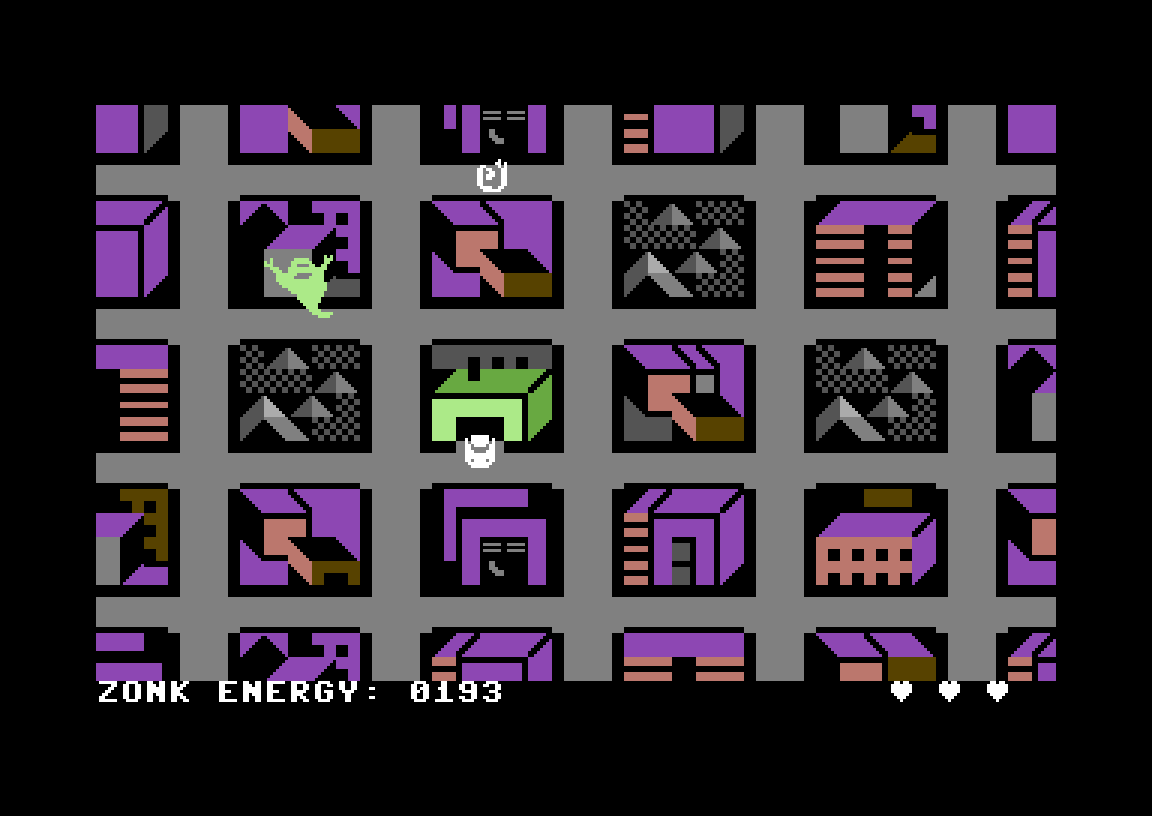
The game is same old, but it has been tweaked a little. This version adds a X2 zonk bonus feature, if you catch the elusive white ghost on the city map. This way you can zonk overload faster.

The game has a somewhat strange logic, from the winging-it school of design. The better you play the faster you get to the end. If you play worse, yet live, the game eventually becomes more difficult. And that's pretty much all the achievement there is.

I generally don't add detailed instructions with the games, because that's the way it was when we loaded pirated games off turbo tapes and disks in the early days :)

But maybe some explanation is in order.


The Last Z-8 v1.1 Instructions

The game is 100% Machine Code for Commodore 64, by Dr. Terrorz. 

Use Joystick in Joystick Port 2.

It is the end of the world, after the bad guys won. The world's a wasteland and everyone is a ghost. Except with you, the last time traveling secret agent, there's a slim chance to revert everything, if you can generate 9999 ZONK and deal a blow to the origin of the disaster.

To generate ZONK energy, you need to shoot or trap ghosts, and to do this effectively you drive a vehicle that is a cross between DeLorean, KITT and Bond's Lotus Esprit. And the last V-8. Except it is the Z-8.

Map Screen. Move up/down/left/right

As the game starts, you are presented with the city map screen. Ghosts materialize at different places. Catch them to proceed to the next step. If you grab the elusive White Ghost, you can activate the 2X bonus feature for this round, generating double ZONK.

Next step is the street patrol sequence, where you have to both avoid the ghosts and jump over any breaks in the road. Shooting at the ghosts will bring them down, adding to the ZONK meter. Note that you can also milk the falling ghosts for more ZONK, but this can be risky.

Street patrol, Move left, right, jump, fire

After surviving the patrol sequence, you will face the ghost trapping sequence. In front of the house, you can launch ghost traps, which will be brought down again when they reach the top of the screen. There's no limits to these traps.

Only when the traps come down, they are effective on the ghosts. At the same time you need to avoid everything, including your own traps!

If you are fast enough, you can trap all the ghosts, adding to the ZONK meter. The higher the ghost is when trapped, the more ZONK will be generated as the ghost descends. This can provide opportunities for tactically waiting for a ghost to recede upwards before trapping it, but if you waste time you may end up not catching the ghost!

Trapping sequence, move left/right, fire to launch trap

After the ghost trapping sequence, you are back at the map, facing the next night. In case you had the 2X bonus, this will be reverted and you need to catch the White Ghost again to activate it.

Each round of the game is in a sequence. This does not change, no matter which ghost you choose to engage on the city maps. The stages and patterns are repeated the same way each game, so you can memorize things to do things better.

When you reach 9999 ZONK, the gate opens and you can go fight the boss and reverse time.

The Last Z-8 v1.1 at itch.io

The Last Z-8 v1.1 at csdb.dk


Tuesday, 5 November 2024

Zoo 2024

Pit Stop

A weekend was well spent at the Commodore 64 demoparty Zoo, hosted at Orivesi.

I'll mostly focus on my game release The Last Z-8, and avoid doing a separate post about it.

Ok, at least something about the demoparty. We took the partybus from Helsinki, which turned out to be 1-2 hours late! It was alternatively amusing and not-so-amusing in the cold, grey sleet of Helsinki.

Elite

In the warmth of the bus it was already fun to reflect on, but the gods of Murphy do not look so kindly on such frivolity, so a tire fell of from the bus before it even got out of Helsinki.

Fortunately a replacement bus arrived promptly and eventually, finally, we got to the party place.

Lopussa kiitos seizoo

What can I say? The concept was largely the same as 2022. The lobby greets visitors with Reprocade arcades and an exhibition of pixel art. The main hall and a second hall are filled with tables for computers and the audience.

The program was filled with compos, talks, music acts and other party features.

Pixeled Years

The pixel art exhibition was the Pixeled Years on tour, with one piece from yours truly too.

With the Party Feature, the "computer fair" elements could compete too, for example AK rigged a C64 to work with a high-end car simulator gear courtesy of Simucube, SIDrock had a matrix printer digitized image service, and so on. Also the usual market of C64 extensions, parts, magazines, stickers and games.

Stunt Car Racer

The crowd did feel a little more international than before, perhaps an indication of how party has grown from the 2013 days, becoming a more credible outlet for big name C64 demo releases.

The number of productions was quite staggering. (Demozoo link)

The Main Hall

I'm no longer very surprised by all the graphic talent, but I have to admit Worrior1's Binary Saint is a grand piece of PETSCII and Sarge "did it again" and maybe exceeded himself with SLOBBER

According to the slides, Multipaint still had a strong presence among the pixeling tools, but Albert is becoming more and more popular I think.

All the Young PETSCII

As my attention had been on creating a game, I could only patch together one PETSCII at the party place, All the Young PETSCII. Given the circumstances I'm strangely pleased with it. Maybe I managed to come slightly outside of my usual style. It landed on the respectable 8 out of 21 position in the compo.

I went all in and submitted a Nick Montfort-inspired Illegal, a 10 PRINT poem, an attempt at teasing something out from the BASIC ROM area where the error messages are contained. Obviously it's not a thing to win any prizes, but it was interesting to try.

Illegal, a 10 PRINT poem

From the main demo event I can't highlight a particular all-round favorite, it looked like one demo excelled in one area whereas some other might exceed in another. Possibly Artline Designs really deserved the win with their coherent Nightfall package. Stereo by Phonics was memorable in using some more unconventional cuts, and the A-side/B-side concept was brought to full fruition with music taking the center stage. Pretzel Logic's Papel is an example of showcasing huge amount of creative talent, but it was perhaps tad too long at that time and hour. Yes, the democompo ended about 3AM, with Extend's demo failing to properly load.

The Last Z-8

For the game dev compo I made The Last Z-8. (csdb link) This took about one month to create, using reasonable time on evenings and weekends, and a couple of crunch sessions near the end.

My workflows and pipelines are rather well established, and I took a relaxed attitude. For once I did not dedicate a whole lot of effort on laboring some technical point. Just sprites, PETSCII graphics as background, no multiplexing, single raster interrupt, some Goattracker tunes and effects.

I also refrained from creating any specific tools, instead using Spritemate and/or editing sprites directly in the source code for the graphics.

Intro Screen

For The Last Z-8, I mixed and mashed various games, but ultimately what it looks like is a Ghostbusters-remake, which is misleading as it's actually not very similar. 

But especially it has nearly nothing to do with The Last V-8, as I decided on the name rather late in the process.

You are first confronted with the post-apocalyptic city map, from where the other game parts are then accessed.

The City map

The car driving sequence is a Moon Patrol-style minigame paying homage to the Parker Brothers' James Bond game, and some elements may be more reminiscent of Ocean's Miami Vice.

In fact, the game started growing from trying to make some kind of send-up of that Bond game.

In contrast to Ghostbusters, you need to avoid the ghosts even in the parts where you'd be vacuuming them in the original game. Instead of trying to keep the "city energy" level low, you are encouraged to maxx it as soon as possible. There's no money and no business and no shop.

Driving to the location

All in all I tried to combine elements from as many games as possible. At beginning, the ambition was larger and I intended to have more silly minigames, but the end result only has two distinct sequences apart from the repeated map/driving/trapping screens.

The map screen has a very minimal effect on how the game plays. You may lose just a slightly more zonk energy if you choose a less optimal route.

Trapping them ghosties

Though I feel releases should be fire-and-forget, I may still want to return to this and tinker the game balance and other aspects. There's still memory left a-plenty. But no promise, really.

The games could be pre-released to the audiences already before the party. After I saw herra47 from Jani Parviainen (link) and Aquarius from Aleksi Eeben (link), I knew one of these would win and my work would place third at best. Which it did!

A detail: my game had a small Leisuresuit Larry -tribute in place, but seeing that Jani was making an entire Larry-based game, I removed it. But the reason the guy sprite is as tall as it is, is kind of because of that Larry reference!

The video could have been better edited, showing more of the game content (there is more) but I sort of doubted it would help, so I just let it show the first few minutes of the repetitive gameplay.

I also participated in the panel discussion led by Mikko Heinonen of Skrolli and V2 "let's play" videos fame, joining with industry veteran Miha Rinne and all-round clever guy Aleksi Eeben. Perhaps there were no huge surprises to the audience, but at least fun was had by the panelists. The enthusiasm tends to be infectious, and suddenly you can see the productions are important to the authors, unlike the typical Finnish "I just did this blah blah nerd thing and it was really nothing".

More Zoo next year!

Sunday, 29 September 2024

No Man's Sky (Linux Proton)

Fixing the broken ship is one of the first tasks

With Proton, I could get No Man's Sky to work easily on Linux/Steam. And no wonder, it's about eight years old and a major release. Back then it got lukewarm reviews at best, but famously the game got a lot of upgrades and now it's supposedly very good. But is it?

After some 10 hours of play, I feel a little uncertain if I will continue far with it.

Coming from 8-bit Elite and 16-bit Frontier, at first I have to say the focus is of course much more on planetary exploration.

Here, docking isn't difficult. Or even necessary.

The basic game play is smooth, I have had no problems or crashes. WASD and mouse your way around, use the raygun to mine away rocks and plants and receive raw materials. Then craft and research and craft and build some more. And then you get past the initial survivalist and tutorial-like phases, and you can choose to fly elsewhere and trade with aliens and build bases and whatnot.

There are occasional reminders of past games. Apart from the obvious Elite comparisons, flying in space reminded me of the hilariously compact universe in Starglider 2. I had some vague Ultima/Space Rogue vibes especially when visiting the space station. But if this was Ultima, I'd already have a more coherent idea of the world and its purposes. I don't expect a linear story—best Ultimas really didn't—but there is some kind of heart missing.

Gaming went through a phase where crafting, upgrading and building had to be added to nearly all games. No Man's Sky is practically built on the entire premise. I'm guessing many are now sick of the excessive crafting and tinkering, and want more straightforward experiences. I know I do.

One of the numerous alien creatures you'll encounter

This is not to say the game doesn't have its moments. But the exceptional events also often amount to nothing, or result in the same humdrum actions you can do anyway. For example, after I built a base a trader landed with its ship to the premises, enabling me to discuss and trade. This felt nice, but I actually had very little to gain from this encounter.

The same could be said with the sudden discovery of a trading post on the planet I was exploring. It was refreshing after the rather repetitive landscapes. A bustle of activity, ships landing and taking off, persons to meet, language to learn, items to trade and ships to buy.

Yet, in the end the characters don't have even the dimensions of the hand-written short keyword dialogues of, say, Ultima IV. Granted, I've not yet learnt much of the Gek language, but it already looks like they have little to say.

Guess we're now spoiled, in 1990s small events such as these would have felt mega.

A trader appears. The Teleport in the background.

I could perhaps look even past all this vagueness, if the game's relation to space was more disciplined. And with this I mean the teleportation, and some details concerning with terrain manipulation.

The game encourages you to build a base and a teleport. After the teleport is built, you can visit the space station you have previously found, and teleport between them. Not only do you teleport, but your spaceship teleports too.

And I'm then left wondering what is the point of the spaceship logistics after all. Ok, after finding more planets you don't immediately have a teleport and a base, but discovering space stations does produce new teleport locations.

This also means the trading and upgrades aren't a minor satisfying prize after a successful journey (like in Elite). You teleport to the station, find you didn't grind enough materials on the surface, then teleport back.

Gee whizz, yet another planet and some crystals to mine

Secondly, the planets mostly provide a repetitive sandbox where everything you materially need is usually found within reasonable distance.

Well, some planets have a decent amount of macro-structure, such as oceans and subterranean caverns. Yet large wrecks, outposts, settlements tend to be the similar and also offer similar activities.

Another thing is the landscape. On first sight it offers obstacles to overcome, but if you insist you can dig a staircase through a mountain with the mining beam. The same item that enables Minecraft-esque manipulation of environment, also tends to trivialize the whole idea of the "landscape". If there's nothing that blocks your way, are you really in a credible environment?

Some happenings in the obligatory all-too-dense asteroid field

I sort of get that if the player can't move fast and teleport between systems, it could make traveling boring. But it's a game design and scale issue to solve. The exploration would be more meaningful and memorable, if it was a little more grounded.

After hitting on something that looks like might be some kind of major quest in the game, things might  begin to improve. The game is also quite good at hinting at future possibilities, such as a wheeled vehicle and different types of spaceships.

It's just sometimes there appears to be so much to do and so many threads to follow, I feel like I can't be bothered with any of them.

Despite all the missions, trading, quests, expeditions, activities and building, I can't somehow shake the feeling this is some kind of gigantic, glorified Farmville, where my next task is simply defined by what I happened to activate previously.

My base, resembling a 1970s detached house. Soon to extend underground.

I can't say the old games always solved these things much better. How Elite got around this was the fact the planets were not genuinely that different, so it didn't matter much where in the universe you were. But it at least used a simple but effective RPG fight/reward structures. 

With Frontier I felt it would be genuinely interesting to visit some distant star system, and you needed to make at least some effort to get there.

Maybe I'm envisioning a perfect space exploration game somewhere in the middle of a triangle made up from Elite Dangerous, Everspace and No Man's Sky:

From Elite Dangerous, I'd take something of the realistic nature of the universe. No instant teleports between star systems, unless as a very rare stargate-type event.

I'm not sure 3rd person walking elements should be part of the game. At least visiting space stations is exciting enough to justify it. No Man's Sky planetary exploration is I guess almost good enough as it is, but as said it could benefit more from planetary macro-structures, unevenly distributed resources and less options for manipulating the environment.

Everspace provided an enjoyable combat system and ship upgrades. Fighting against larger ships was an interesting challenge and sometimes even tremendous fun. Also the derelict ships, space stations and large asteroids were nice environments for exploring.

Exploring an underground cavern

Granted, I haven't yet seen much of what No Man's Sky has to offer, but it quite doesn't yet have the pull on me. It's a little weird that I got most Elite-vibes from Everspace, even if it's not very open. Or perhaps just because.

Thumbs up to No Man's Sky as a huge Proton-enabled game.