Wednesday, 22 February 2023

ChatGPT bandwagon: recommend 1990s games

The ChatGPT bot has a good reputation for making lists and summarizing things, so I asked it to make lists of 1990s computer and video games.

First question

"Give me a recommendation of important 1990s video games, including computer games. Make a balanced list between games from Japan, Europe and the United states. Use popularity and influence as a metric, how well known the games were and how much they influenced later game design. The list could include 20 games."

*

Sure, here are 20 important video games from the 1990s, grouped by country of origin:

Japan

  • Super Mario Bros. 3 (1990, Nintendo)
  • Street Fighter II (1991, Capcom)
  • Final Fantasy VII (1997, Square)
  • The Legend of Zelda: Ocarina of Time (1998, Nintendo)
  • Metal Gear Solid (1998, Konami)

Europe

  • Lemmings (1991, DMA Design)
  • Worms (1995, Team17)
  • Theme Park (1994, Bullfrog Productions)
  • Tomb Raider (1996, Core Design)
  • Championship Manager 2 (1995, Sports Interactive)

United States

  • Doom (1993, id Software)
  • Myst (1993, Cyan)
  • SimCity 2000 (1994, Maxis)
  • Half-Life (1998, Valve)
  • Starcraft (1998, Blizzard Entertainment)

Japan/Europe

  • Sonic the Hedgehog (1991, Sega)
  • Pokémon Red and Green (1996, Game Freak)
  • Resident Evil (1996, Capcom)
  • Shenmue (1999, Sega-AM2)
  • Gran Turismo (1997, Polyphony Digital)

These games were all highly popular and influential, and helped shape the gaming industry as we know it today. Each one has had a lasting impact on game design and player experiences, and many of them are still beloved by gamers today.

My observations:

A nice list, not sure why there's an additional Japan/Europe grouping.

I feel the games are well chosen for both popularity and being prime examples of works that helped establish a genre. There were many significant JRPGs before Final Fantasy VII, but it is the game that cemented the popularity of the series also in the west. Tomb Raider made third-person 3D action games interesting, and so on and on.

"Game Freak" is listed as publisher for Pokémon, although "Nintendo" could have been used.

Championship Manager 2 sounds weird to me, but then again I don't know the genre and its significance at all. Trust the bot with this one?

Second question:

"Please also make a list of obscure computer and video games from 1990s, that many do not know yet still shaped the industry."

Certainly, here are 10 relatively obscure computer and video games from the 1990s that had a significant impact on the industry:

  • System Shock (1994, Looking Glass Technologies): A first-person action-adventure game that pioneered many gameplay mechanics still used in modern games, such as audio diaries and RPG-like character progression.
  • Thief: The Dark Project (1998, Looking Glass Technologies): A first-person stealth game that introduced many now-standard stealth gameplay mechanics, such as hiding in shadows, leaning around corners, and pickpocketing.
  • Ultima Underworld: The Stygian Abyss (1992, Looking Glass Technologies): A first-person action-RPG that was one of the first games to feature fully 3D environments and non-linear gameplay.
  • Syndicate (1993, Bullfrog Productions): A real-time tactical game that popularized the concept of controlling multiple characters simultaneously and the use of cyberpunk themes.
  • Betrayal at Krondor (1993, Dynamix): A role-playing game that featured a complex story and well-developed characters, and was one of the first games to use 3D graphics for its world map.
  • Grim Fandango (1998, LucasArts): A classic adventure game that used a unique art style and a combination of 3D and 2D graphics to create a memorable, film noir-inspired world.
  • Gabriel Knight: Sins of the Fathers (1993, Sierra On-Line): A point-and-click adventure game that blended horror, mystery, and history into a compelling story, and featured some of the best writing and voice acting of its time.
  • Descent (1995, Parallax Software): A 6-degree-of-freedom first-person shooter that allowed full 3D movement and was a technical marvel for its time.
  • Battlezone (1998, Activision): A hybrid first-person shooter and real-time strategy game that used a unique blend of tank combat and base building.
  • Star Control II (1992, Toys for Bob): A sci-fi adventure game that combined space exploration, combat, and role-playing elements to create an immersive and unforgettable experience.

These games may not be as well-known as some of the more mainstream titles from the 1990s, but they all had a significant impact on the industry and helped shape the future of gaming in their own unique ways.

My observations:

These were actually well known games at their time, but I wouldn't except younger people to know these now. I like how the first list included some brands and franchises widely known even now by "non-gamers", whereas none of the same games appear here. The list has become exclusively about PC games.

Interesting that the bot remembers some of my qualifiers from the first question, but chose not to give a Japan/Europe/USA balance here.

I'm maybe less qualified to say whether all these games were both obscure and influential. System Shock and Ultima Underworld alone were portents of things to come, even though the ideas in them were largely abandoned in favor of simpler games like Doom and Tomb Raider.

I didn't check the release years one by one, but I can see the bot gives publishers for some entries and developers for others, a mismatch that one could easily make when compiling such lists.

I'm not sure why I needed to say "please" here.

Third Question:

"Now, one more list with really non-commercial, public domain, fringe and cult computer and video games from the 1990s that were not sold in high street stores."

*

Sure, here are 10 really obscure, public domain, fringe and cult computer and video games from the 1990s that were not sold in high street stores:

  • ZZT (1991, Tim Sweeney): A shareware game that allowed players to create their own levels and stories using a built-in text editor and simple graphics.
  • ADRIFT (1995, Campbell Wild): A text adventure game creation system that allowed users to create their own interactive fiction games using a simple interface.
  • Captain Blood (1990, Exxos): A surreal and trippy adventure game that takes place in a strange alien universe.
  • The 7th Guest (1993, Trilobyte): A puzzle game with live-action video sequences and a horror theme, which was one of the first games to be released exclusively on CD-ROM.
  • Bolo (1993, Stuart Cheshire): A real-time strategy game that focused on tank combat and was one of the earliest games to support multiplayer over a network.
  • Angband (1990, Alex Cutler): A roguelike game that features randomly generated levels and permadeath, and is still actively developed and played today.
  • Slime Volleyball (1998, Quin Pendragon): A simple and addictive one-on-one volleyball game featuring blobs of slime.
  • WinTrek (1995, Dan Baker): A multiplayer game that allows players to command their own starship and engage in battles with other players over the internet.
  • Nethack (1993, The NetHack DevTeam): A classic roguelike game that features randomly generated levels and a vast array of items, spells, and enemies.
  • The Incredible Machine (1993, Kevin Ryan and Jeff Tunnell): A puzzle game that challenges players to use various everyday objects to create Rube Goldberg-style machines to complete a goal.

These games were not sold in high street stores and are relatively unknown to most people, but they still had a significant impact on the gaming industry and helped inspire future generations of game developers.

My observations:

Ok, that's pretty obscure and included also games I haven't heard of. Still, the "not sold in high street stores" part was not taken very strongly, because Captain Blood and The Incredible Machine were commercial games.

The bot may have considered the categories as broadly inclusive, because certainly Captain Blood is a cult game.

Here I felt the need to actually check the list entries.

One entry I consider a full error. ADRIFT appears to be an adventure-authoring system, and not a game as such. Besides, it was released in 2002 according to Wikipedia. I didn't challenge the bot about it, but presumable it would argue the author already was working on it in the 1990s.

Captain Blood was, according to many sources, released in 1988.

Bolo might have been originally released in 1987, but I'll give the bot a pass as the later Macintosh version is probably the more significant one.

Angband probably has more credits than "Alex Cutler".

According to sources I could find, Wintrek was not authored by Dan Baker but by Joseph Jaworski in 1992.

Slime Volleyball has apparently a somewhat contested authorship and year of release.


Overall

The bot did a good job in my opinion, it mostly didn't invent bullshit or non-existing products, kept in 1990s almost entirely, and made relevant suggestions. For the last category, there seem to be more uncertainty about authors and release years.

I didn't ask for game descriptions, but these were actually relevant for the less known games and as far as I see they are quite correct too.

Sunday, 19 February 2023

Multipaint 2023


With no Multipaint "yearly" release for 2021 and 2022, I thought it was high time to get a version out.

The hiatus was at least partly because of Covid. But maybe not in the way one would expect. You see, for some reason 2020-2021 was at first a time for ambitious new ideas and concentrating on hobbies. This led me to create a huge internal overhaul for Multipaint that eventually became something of a burden, locking me out of a release for a long while.

Often it was like "It would be nice to get that pan tool feature out, but the script features are far from being finished!"


GUI and functions

Indeed from the user point of view one of the biggest additions is the pan tool. In magnify, you can either use the "hand" icon, or hold down the middle mouse button to drag the view.

In the full screen view the pan tool doesn't do anything, which is not that intuitive. Programs like GIMP allow you to drag the full image around, which is kind of useful when preparing to zoom in.

The Multipaint viewport may need rethinking in the future, but I would also like to preserve the 8-bit/16-bit style "full screen" drawing.

The text in menus and buttons now also uses both upper and lower case, which I hope is slightly more readable than the past UPPER-CASE menus. The characters were tweaked a little too, but as it's a monospace, there are always some compromises.

Multipaint 2020 scaled the contents of the window depending on how the full screen fit into the application window. Resizing the window switches between 1-3x scales. Now it's also possible to force one of the scales from the Other menu.

This can be helpful for some situations where you need to fit Multipaint to a low resolution laptop screen. The viewport may overlap the tool palettes, which I didn't fix for now. Using the forced scales, the user is responsible for setting the window size anyway.

The file selector caused some problems for Windows users, which I already knew from Marq's PETSCII editor. Instead of revamping the themed file selector code I disabled it for Windows altogether, which according to one test helped enough. From prefs.txt it is possible to force it back on, in case someone wants to test if the slightly better file selector works.

I adjusted the grid terminology a little. I had happily used "8x8" grid for what was technically a "4x8" grid in wide pixel modes, now it ought to be more consistent.

New Modes

A kind of Amiga mode has been "unofficially" part of Multipaint for a while. However, Multipaint 2023 finally has a resizable, bitplane-adjustable mode that I could properly call Amiga.

Currently it only exports IFF, and cannot load it in, as I found it to be somewhat complex. What kind of IFF would I support? Possibly a Deluxe Paint 3 output would be enough.

Obviously it can handle the Multipaint "*.bin" project format and png load/save, so it's not something to worry too much.

The resize-function is still rather limited, and there's an invisible memory limit to which the mode has to fit into. I consider this an Amiga "low resolution" mode although you can use 1 bitplane and create a 640x400 bitmap.

I guess this would also work as an Atari STE mode, although I haven't written a Degas exporter specific for this mode.

Why even do an Amiga or Atari ST? I no longer remember. Multipaint originally concentrated on 8-bit modes, and it might have been good to hold onto this constraint. For a while, Sinclair QL was my favorite retro machine, resulting in a new mode. Then Atari ST was done as it could be done just as well, and then I began to think what an Amiga mode needed.

VIC-20 hires and multicolor modes were a late addition. I have wanted VIC-20 modes for a long time, but was always somewhat confused with the different implementations, some of which required extra memory and even extra hardware. Aleksi Eeben (thank you!) supplied practically a white paper with specs and examples and a format that could make most out of the unexpanded VIC. I could not resist adding the modes.

Extras Menu

I added an Extras dialogue in the File menu for running less complete, experimental or non-standard modes. I couldn't live with the idea the main platform selector was cluttered with these, but I still wanted more easy access to them for the user. In the future I may revamp the platform selector and again combine the menus somehow.


One of these is the ULAplus direct mode, which is like ZX ULAplus, but the mode doesn't attempt the notorious "live" palette adjustments of the original mode. So it's bit like working on a normal ZX Spectrum with 64 color adjustable palette.

If you turn over to the real ULAplus mode, Multipaint will then convert the image to the real platform limits. Although I've allowed 64 colors, I'd recommend using maximum of about 16, especially because there seems to be something a little wonky about the internal conversion still.

I added a C64 multicolor free mode, similar to the C64 hires free mode. This is meant for experimentation with non-standard C64 ideas, such as mock-up sprites or border effects, or create larger than screen-size bitmaps. Or make pretend you are in a FLI or some such mode.

I also enabled the resize-function for these two modes. Admittedly Multipaint is currently not very good at handling larger screens. I have some ideas about how to expand the usefulness of these modes.

I was asked to add an Amstrad GX4000/plus mode, and it turned out so easy to create I put it to the Extras. This computer enjoyed some popularity in France, but it is not well known for the rest of the world. I do remember it was advertised in Finland. The mode is 160x200 with 16 colors out of 4096 maximum.

Scripting

The biggest change to Multipaint is not really visible to the user at all, the external script functionality.

All the export/import functions were previously written inside the Multipaint source code. Although I could reuse components, this approach began to look like a growing problem if I were to add more modes. Likewise, the component-approach meant that if something broke it could affect multiple other modes. The text exporter was also getting to be a little messy.

Now, Multipaint loads a boot.txt script that defines what other scripts are attached to the current platform File menu and what role they are to play. These scripts in turn use a primitive BASIC-like language to convert the Multipaint internal format into an 8-bit format or executable.


Of course the interpreter takes room in the Multipaint source, but adding new import/export scripts doesn't clutter the source and each platform has a self-contained script. Well, the Amstrad CPC disk baker uses two layers of scripts which I don't like, but it was necessary.

I also encountered the fact that a lazy implementation of a script interpreter isn't especially fast in Java/Processing as the string appending, clipping and concatenation can be costly there. Making it faster took some while, and I can only hope the export/imports are rapid enough.

I'm not yet prepared to say it's a good idea to create your own scripts, but it is possible, they are located in the data folder just as the prefs.txt is.

Into the future

There's actually a bunch of to-do ideas hanging around for a long while, yet I didn't get them into this release version. Now that the scripting idea works I could consider some more lightweight additions.

One future idea is to enable user-creation of modes that are similar to the already existing ones. For example, Amstrad GX4000 was basically a combination of already existing modes and palette selector definition. Almost anyone could have added the mode, except the Multipaint source is so convoluted only I know my way around it.

However, the VIC-20 modes, despite seemingly based on similar concepts as other modes, still required quite a lot of tweaking. So, who knows.

I probably need to look into Processing 4, just to keep up with the official developments.

Multipaint web site:

http://multipaint.kameli.net


Sunday, 5 February 2023

Jill Lepore: IF THEN

I was lured in by the initial impression this book would have stories of old-timey punch card computers and their operation. Not really. This is more of a political story revolving around computers and their application in behavioral science-led questions. And all the better for that I think.

If Then: How One Data Company Invented The Future, from the historian Jill Lepore, weaves together politics, university life, zeitgeist and popular culture, in an attempt to explain how computer prediction and data analysis came to impact on politics and public perception in the 1960s.

The prologue and backdrop is the famous event of televising the 1952 presidential election, doubled with a televised UNIVAC prediction of the outcome. For some inventive minds, the event suggested that instead of using computer to report vote results faster, a computer might influence who could get elected.

Simulmatics

Through the era of Dwight Eisenhower, John Kennedy, Lyndon Jonhson, Vietnam, Martin Luther King, emerges an unlikely narrative of the Simulmatics Corporation, a company that used behavioral science-based computer modelling to predict people's actions. A "people machine". 

The Kennedy election in 1960 was followed by a bold claim from Simulmatics that their reports, based on number crunching and 480 voter types, resulted in policy suggestions that landed Kennedy the presidency. Through mist of assertions, denials, counter-denials, fiction and non-fiction, it is probably impossible to say what the real impact was.

Among the cast of characters, the author details the involvement of Eugene Burdick, now a largely forgotten Hollywood-celebrity author of political thrillers with a sci-fi bent. His book The 480, was a fictional account of Simulmatics, and not from a neutral perspective either. 

Although the claimed influence resulted in a sort of a scandal in itself, the novel probably ignited more debate and public opinion about computers than anything else. The fear of computers predicting what people will do and government reacting to it before people themselves knew what they were about to do, seemed to become real rather soon. Whatever the truth, the idea of a candidate led by a computer entered into the popular culture big time, reducing voters into punch-card caricatures with no agency of their own.

Simulmatics banged their drum with the Kennedy report, also basking in the (somewhat indirect) infamy of The 480, but didn't have it easy with subsequent clients. Politicians and the administration were understandably not too keen to rely on the company, and other industries didn't have that great data or didn't want to give it away. 

Rather quickly, advertisement companies with long history and large databases could do their own computing, and Simulmatics was left in the sidelines in the field they helped create.

Vietnam war provided a life extension for Simulmatics, as they set up shop in Saigon and attempted to collect data for predicting insurgencies and find opportunities for propaganda and soft warfare. Simulmatics was hardly alone in this, but at least in this telling it looks theirs was the most incompetent and shoddy research setup, an exemplary of how not to conduct social research in another country.

In meantime, administration had changed and Nixon hardly had use for an outside predictor company, as voter segmenting and balancing segment responses to policy changes with estimated votes, were already old hat. (It's unclear whether Simulmatics offered to politics anything new in the first place, except more speed and "real time".)

The book then continues exploring the latter days of Simulmatics, its entanglement to the civil right questions and the black vote issue, a supposed linchpin of the Simulmatics report for Kennedy. Back in USA, Simulmatics engaged in predicting not rural insurgencies in another country, but riots in the urban areas. In fact it seems "predicting riots" was something of an ongoing sub-genre in the area of behavioral science applications.

The author is then able to weave and knot the story of the corporation to the moment when the two political parties began to polarize in the way we now recognize. This is perhaps more zeitgeist represented by the story of Simulmatics, rather than Simulmatics or computers being a direct root cause for it.

What strikes as both funny and terrifying is the unprincipled nature, even corruptness of it all. In absence of data, Simulmatics would cobble up some, patch it with educated guesses, then present results to clients. Again, this speaks likely more about the time than about Simulmatics or the field of computer-based behavioral science. But I can’t avoid having flashbacks to university innovation and research activity.

Of the central cast, to me the only relatively familiar figure is Ithiel de Sola Pool, whose name became tarnished through the Simulmatics/Vietnam association. MIT students protested vocally against defense funding of research projects. The opposition was even extended to the openly presented and rather innocent Arpanet, the consequences of which hardly anyone understood at the time.

Here these two developments at least touch each other in history. Simulmatics, representing the more graspable idea of government control over people through mainframes, and "reducing people into punchcards", was still a name brand at these debates. It was soon forgotten from history whereas the developments that grew out of Arpanet grew into global importance.

Later, Pool was able to predict in great accuracy the consequences of a world-wide internet: in principle anyone can have personalized newfeeds and therefore live in reality-bubbles of their own, or get behind fringe ideas by networking in ways that were impossible before.

Recounting the legacy of Simulmatics, Lepore appears to liken Media Lab as a continuation of the practice of milking government money for grand promises of technical revolutions, a "Simulmatics scheme" of sorts. Not sure if I got this correctly, or perhaps this is a case of Harvard bashing MIT or something.


Looking Back

The book makes the always gleeful and enjoyable demonstration that a technology we thought was new, was actually used a long time ago and largely abandoned. Perhaps even for moral and ethical reasons. And then as time passed it came to be done anyway, by the Cambridge Analyticas and the Facebooks of our age.

This requires the insight that the mainframe-as-predictor, and the large-scale internet practices of user data manipulation can be juxtaposed, and to make say something about each other. What could have been a historical footnote becomes more important through the lens of the present.

Apart from mentioning IBM computer models and bit about FORTRAN and punch card tech, the hardware is not meticulously explored. The algorithms are simplified into kind of IF-THEN evaluations (hence the title), so as not to confuse the more casual reader. Then again, the US election system is not explained in any great accuracy either, so the text is able to cast an overview of a web of events without boring anyone greatly.

From today’s perspective, Simulmatics was a fledgling attempt at best, and would seem naive if it wasn't acted out against the backdrop of presidential campaigns, civil right questions, the Vietnam war, and a world on brink of nuclear destruction. Certainly the story is a precursor to the data analytics practices later embraced by any large-scale commercial or political internet operation.

It's also darkly funny, this story of the would-be Merlins in Kennedy's collapsed Camelot. The writing is infectious, making me feel like I'm suddenly an expert in areas I had no knowledge of prior to reading this book. Perhaps the author also borrowed a leaf from Eugene Burdick's supposedly lurid and unsubtle prose, as if to show the pen is mightier than the punch-card after all.

Thursday, 19 January 2023

Giana Sisters 2D/DS

I played Giana Sisters 2D through Proton/Steam on Linux, and on the force of love for the C64 original I could complete the game and even enjoy it in parts.

In concept it's not that different to the original Great Giana Sisters, jump and run your way to the end of the level and collect diamonds as you go along.

With this PC version it's just that the graphics are vector-based and more mobile-like, and somehow I felt the general level of polish is not as high as it could be.

As this is a re-versioning of a 2009 Nintendo DS game, I became curious enough to order the game off eBay and borrowed a Nintendo DS hand held console to see how this really plays.

Let's dive in.

It was more easy to take screenshots from the "2D" version.

New Coke, New Giana

For the new Giana, the designers made an important streamlining. When becoming "punk", Giana gains both the head-butting ability and the fireball. You can also shoot multiple fireballs, importantly the power acts as a kind of one-hit shield so Giana does not instantly lose a life.

There are no additional bonuses for creating reflecting missiles, homing missiles or the one-off bonuses found in the original game. This means it isn't so devastating to loose your "punk", as the next bonus will bring it all back and there's nothing further to build. Admittedly some nuance is lost here, but this change helps make Giana Sisters more playable on the long run.

From the start we see the game can scroll vertically too, and although many of the initial levels are horizontal they can be traveled back-and-forth, unlike the C64 game. Later the levels expand to all directions, steering away from the original level styles, but admittedly they bring some needed variety.

Part of the World Map

One central new idea is the occasional red diamond found among the usual diamonds. This is not only a nod to the Amiga version which had red diamonds, they are special jewels. Collect all from one level, and you have cleared it perfectly. Clear all levels in a world to perfection, and you can access a bonus level of that world.

The red jewel is also why some levels are worth exploring forwards and backwards, up and down. Later it will become increasingly hard to discover all the red jewels. You can play a level again if you didn't clear it perfectly the first time around. This adds some replay value as I just didn't care when sweeping the levels on the PC 2D version.

The red jewel is also a likely reason for why the time counter for levels is extremely generous. You can leisurely explore the whole area searching for those hidden jewels. Still, I got the feeling no-one really tested meticulously what would be a good amount of time for any given level, so they just gave a bunch.

Extras

There are also two additional tools for Giana. First, it's possible to get a bubblegum or a soda from a dispenser. The former allows Giana to float in a balloon, whereas the soda produces a Turrican-style beam of water that can be rotated momentarily around Giana. 

Wheee!

Here some of my problems begin, at least on the PC version. Floating on a balloon, avoiding sprites, is something that I could have cooked up as a C64 BASIC game in the 1980s and the movement is just as sluggish. And of course there has to be at least one hell-hole of a level that requires the player to navigate the balloon in a corridor of spikes and flames and bees. The 8-8 level particularly can F.O.

The DS version at least has better controls and Giana doesn't jank around in the bubble when flying. It still doesn't become my favorite part of the game. There's an option to use the microphone to blow the balloon upwards, but I shudder even to think of this.

The Soda gimmick is mostly just a "key" to open areas, as it washes out breakable walls and obviously blows out any flames. It's said to push monsters too, but at least the crabs didn't seem to care much about it and I ended up losing a life because of this misinformation.

Splosh. Also, the inevitable glitch.

The two extra items didn't do much to the Giana experience, but as a way to open bonus areas they are more inventive than just plain keys or warp items. On the DS, having to press the touch screen to activate the bubble gum does not add much, or actually nothing. 

The game doesn't make much use of the double screen anyway. The information and world map is at the bottom screen, which means you have to slide your eyes there to check if you have all the red diamonds. So, it's one area where the PC version could be said to be better.

Both versions have a look up and look down function, which in theory adds to the process of searching secrets on some levels. It tends to be a bit useless, although fortunately not too distracting.

Levels and difficulty

Part of the main game levels are clearly based on the original Giana Sisters material, and I enjoyed these the most. Although it also felt like visiting the ruins of a partly abandoned gianaverse. These tribute levels have no warp tiles, and although the spaces for the spider and the dragon bosses are there, the bosses do not appear.

Instead the Dragon, now somewhat flatulent, makes an appearance in a separate sub-level, where you need to jump on top of the dragon to kill it. In the Nintendo DS version, the Dragon is more formidable. It moves faster and swoops down on you on the first instance. With the PC game, I felt that nearly all the dragons were quite simple up until the last one or two. We don't get to see the giant spider.

Amiga-esque

The difficulty ramp is one of the more annoying aspects of the game, at least on the PC version. With DS I can't say much because I'm in effect playing the same levels again with better controls. Although at times the small screen makes things harder to see than on the PC.

The PC experience was that for a long while the game is mind-numbingly simple, playing lazily I still had 10+ lives at my disposal. Suddenly it becomes significantly harder and not always in the way I'd hope for. The typical way to die is to bump your head at a thing you didn't properly understand, ending up in a chasm instead.

On Nintendo DS I had 20+ lives at one point. It's possible the balancing of the game and the amount of content is not exactly on par with best console jumping games, but it's a Giana game alright. It may be that as I spent some time in summer to complete the C64 version, the new game felt comparatively easy.

One more detail about the version differences. When the bouncing spiky balls are first introduced on PC, I thought I would have to jump over them much like the similar opponents in the original game. No way this could be done, and I lost many lives trying it. Then I realized I have to go under them instead. Funnily enough in the DS version these spike-balls jump considerably higher and it is more obvious you can pass under them. Hmm.

On the Nintendo DS

The prize for least welcome new enemies are the ghosts, as they simply float around in broad circles larger than the screen, and disregard the physical world around them. They also figure into the "avoid sprite" game mechanic territory which feels a little out of place. I don't think there is a precedent for them in the Giana lore either! My opinion didn't change much on the DS, as added vileness they are maybe even less easy to see.


Looks and feels

The PC version has a "retro" Giana level set, which remixes the original game levels more consistently, but with the new controls and monsters. And a remix it is by necessity, not all the monster types are reproduced, the secret cave logic isn't the same, and so on and on. The DS version doesn't have this game option as far as I know.

The vectorizing of elements on the PC has not been always successful but there have been a few bright ideas here and there. For example, using an airbrushed look for some of the graphics, harking back to that weird Giana Sisters Amiga game cover and loading screen. Then again some of the grass splotches and plants look horribly ill-defined.

Squish those eyes

I'm glad the game is not pumped up with some kind of between-level narrative or text, although for some people this might be a minus. After playing further it's apparent Giana Sisters DS/2D is not a very complex or content-rich game. In this way it further reminds me of the Commodore 64 days.

On Nintendo DS, it is even more apparent how close this actually is to the Commodore 64 game, especially the early levels. The pixel graphics and the atmosphere are spot on, the controls are similar but smoother.

On the other hand, the DS screen is very tiny and not super-high quality. In a perfect world I could somehow play this exact DS version on a CRT monitor.

The DS has nicer looking Giana sprite, and the "punk" version has better attitude and animation than the PC 2D. Truth be told not all the levels look very grand on the Nintendo either, some underground tunnel levels are not on par with the best outdoor ones.

Verdicts

If I'm generous and have my nostalgia lens on, I could see Giana Nintendo DS as a 8/10 game. The PC "2D" version could be a 6 or 7/10 -ish, it still gives enjoyment especially if you're on some kind of Giana binge.

Giana timeline:

1987: The Great Giana Sisters

2009: Giana Sisters DS

2012: Giana Sisters: Twisted Dreams

2015: Giana Sisters 2D

2015: Giana Sisters: Dream Runners

Wednesday, 11 January 2023

Karl Bartos:The Sound of the Machine


I had a German language edition of this 2017 book already a few years back, but after struggling through few pages I gave it up. Now I'm holding the 2022 English edition in my hands.

Although this is an artist autobiography of Karl Bartos, it also tells the story of Kraftwerk from his perspective, and how it befell on him to join Ralf and Florian's project as an electronic percussionist.

As the story goes, Autobahn became a hit in the US, and the band embarked on a tour over the Atlantic. This likely provided them with a great bonding experience that helped establish Bartos (and Wolfgang Flür) as regulars in the lineup. Perhaps it also convinced the foursome that Kraftwerk had a future at all.

Bartos shared writing credits in many songs during the productive era, so this book could potentially shed light on how the works were created.


Starting the machine

About fifth of the book is dedicated to pre-Kraftwerk days, starting from childhood and tracking Karl's increasing musical competence and diversity. At one moment he could be doing pop and rock covers and backing work with the Jokers on a national level, then playing a vibraphone at a classical concert. The main message here is that Bartos not only had experience as a practical musician but was really the only "theoretically" trained musician in the line-up. The story of applying to the conservatory is amusing, as it doesn't sound very formal.

This background allows him to assess that Ralf and Florian were not big on music theory. More importantly, they instead applied a kind of minimalist art sensibility to sound, arising from the growing kraut/cosmic/psychedelia scene doing rounds in galleries and other unlikely venues.

This is not to say Ralf and Florian were "ordinary" people, as they were embedded in the cultural scene of Düsseldorf, and apparently had more money than most of their experimental contemporaries. Bartos describes Ralf as having a keen entrepreneurial eye over the Kraftwerk project, perhaps for both better and worse.

Whatever the reasons, Kraftwerk achieved a remarkably consistent "European" interpretation of pop-sound, stripped of blues and rock influences, even shedding the psychedelic/cosmic aura in the process. If Kraftwerk did anything "first", it was perhaps this consistent portrayal of themselves as a synth-only band, producing album after album of quality music, paving way to a future where electronic music was no longer esoteric or one-off novelty.

The Magic formula

As the book turns to the Kraftwerk years, the narrative becomes a chronology of events using the album releases as milestones, examining individual songs. A common structure in Kraftwerk literature, however having Karl Bartos recollect it makes it more interesting. The book doesn't really try to explain how Kraftwerk came to be, but he gives a summary of the earlier days.

It is instantly clear that Bartos won't explore all songs in great detail. On occasions there are interesting recollections about how the songs were put together and who did what, whereas some are passed over almost completely. For example, he has nothing to say about the Paul Hindemith melody quote in Tour de France, glossing it over as "film music".

Possibly Karl doesn't want to fabricate things where he suspects his memory wouldn't serve him right, but at times I felt the book could have been a little more colorful when describing encounters with other artists. Instead, Bartos occasionally digresses into historical sidetracks, explaining the origins of electronic music, musique concrète, the presence of onomatopoeia in classical music and the life and times of Wernher von Braun.

I don't mind, these add tapestry to what could have been a very one-dimensional autobiography. But for example, an even more accurate description of their studio and song-making processes could have been of interest.

Bartos interprets the "golden years" of Kraftwerk as resulting from the equilateral triangle of Ralf, Florian and Karl himself working creatively and informally in a state of flow in the Kling Klang studio at Mintropstraße. Whereas the initial concepts, melodies and lyrics could be brought to the table by Ralf, Karl would work from his experience from both classical and pop worlds. This was not limited to percussion. Florian would tinker with sound effects, vocoders and speech synthesis–not a small part of the band's signature sound.

Karl attributes a lot of the development of the late 1970s Kraftwerk sound to sequencers, for example the Triggersumme and Synthanorma, which could handle increasingly complex loops in those pre-MIDI times. It is then not surprising the band would continue to follow new technical trends in order to rejuvenate their interest in music-making.

Somewhat closer to my blog themes, from the late 1980s MIDI-era Karl mentions Sequencer Plus (Voyetra) as his software of choice, an early graphical and mouse-compatible MS-DOS sequencer, yet based on the text mode. In an interview from 1998, available on the SoundOnSound website, he discusses his "little Yamaha C1 music computer" with 8 MIDI out ports, which he still used 10 years after its release with the same software running in it. I didn't know Yamaha had another go at the Music Computer concept after the CX5M MSX.

Without Karl really saying so, the various technical apparatuses might be considered the "fifth" member of Kraftwerk. Obviously there were a number of important sound engineers and associates that could also fit in that role. The currently touring personnel Fritz Hilpert and Henning Schmitz emerge from these positions and have in fact been associated with the band for a rather long time. Emil Schult, despite (or because) being a visual artist, could also have a claim of being a 'werker, and he also shared songwriting credits.

Oh, and although Kraftwerk had bespoke gear and the impressive Kling Klang studio set, they didn't really "build their own synths".

As is usual in Kraftwerk literature, the album Electric Café is cited as a failure. Bartos is perhaps more entitled to say this than most, and I can understand it from an artist's point of view: Five years were spent tinkering on the record and it barely visited the charts.

Karl gives a lengthy interpretation of the album's failure as a combination of forgetting the aforementioned music-making methodology that led to the successful albums, the poorly thought out renovation of the Kling Klang studio which also encouraged working in a detached way, and the insistence on trying to replicate or improve on the synth sound now ubiquitous in the charts. Bartos also feels that the increased focus on dancefloor music was harmful to the developments.

To me, even if a commercial and critical failure, the album perhaps aged better than many contemporaries. In an age when the "warmth of analogue sound" has become a saturated cliché, this cold and stark echo-chamber of digitalized musical ideas feels novel in comparison.

Later Years

Karl Bartos was hungry to do more musical work, with or without Kraftwerk, but as Ralf and Florian put an embargo to any solo projects, he felt he had to leave the band behind. It happened surprisingly late considering how problematic Bartos saw the situation already in the early 1980s.

It is astonishing that the band did not do concerts for almost ten years, at a time that appears in retrospect as the peak of their creativity. But as Bartos tells Kraftwerk didn't get huge audiences with their early 1980s gigs, and with the bulky gear they had the motivation to tour must have been low. After the success of The Model there might have been more demand, but apparently Ralf refused to tour.

How could anyone have known that months would turn to years, and years into a decade. A decade that sported an isolated single and a strained album release, culminating into the retrospective self-remix album The Mix. In some ways, the process of "cataloguing" the Kraftwerk sound had already begun in mid-1980s.

After leaving Kraftwerk, Bartos has done a surprisingly large number of projects, solo albums, remixes, production work and other appearances. For those who didn't actively follow the "ex-kraftwerker" career, this output was likely not very visible.

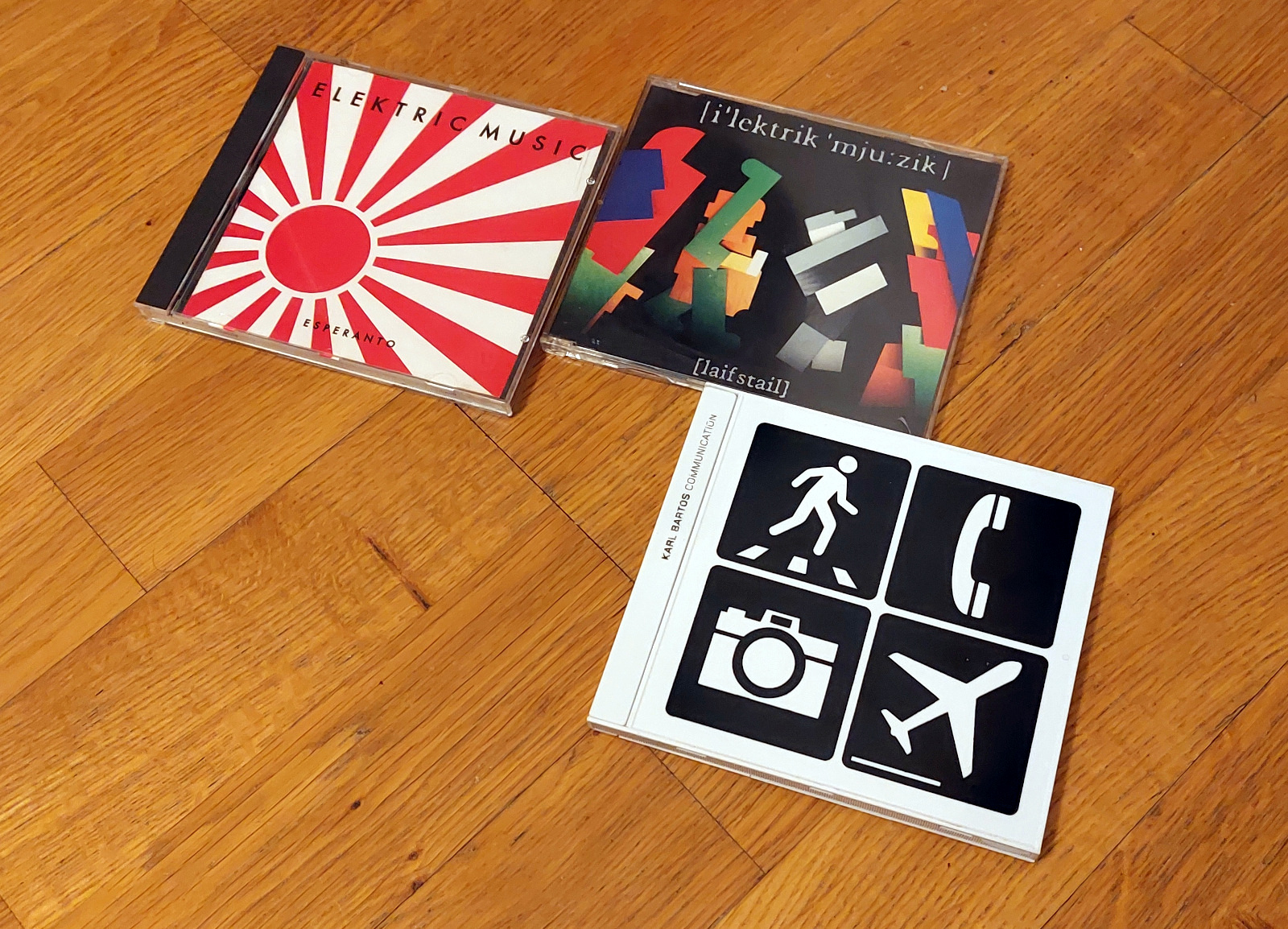
But even I was aware of Elektric Music, the project between Bartos and Lothar Manteuffel of Rheingold fame. Esperanto was a good straightforward electro-pop album in the vein of OMD and Depeche Mode, decked with a recognizable Emil Schult cover design.

Despite having material towards a second album, the project broke up. Considering how much Bartos discusses the dysfunctionalities within Kraftwerk, it's a pity the closing of this chapter is not explored in more detail.

The solo album Communication from 2003 was unfortunate in that it co-incided with Kraftwerk's Tour de France Soundtracks. Bartos laments the timing and being overshadowed by his former band. Although the album is solid, I felt it was burdened with the somewhat heavy vocoder/robot sound.

The book doesn't discuss Wolfgang Flür that much, possibly allowing his story to live in his own autobiography "I was a Robot" from 2000. In this telling it even looks like Flür didn't so much "leave" Kraftwerk, but simply did not bother to come back when his playing was required, instead preferring to focus on his interior design work. I've sometimes wondered why Bartos and Flür did not subsequently collaborate, and the book gives no answer to that.

I am slightly worried that Karl's voice in this book isn't as determined as in some of his past interviews, where he might discuss gear and events in more detail. Has he "bought" the commonly accepted narrative about Kraftwerk, and fills the gaps of his memory and notes with it? How reliable is this narrator?

Much like that Wolfgang Flür outing, this book gives just one piece of a larger puzzle. Anyone interested in Kraftwerk needs to read it. But the ultimate mystery of Kraftwerk, if there really is one, does not become really closer to being revealed. Ralf Hütter's public utterings are repetitions of past and mostly intentional riddles anyway, Florian Schneider is dead and can no longer answer questions. Possibly the long-time collaborating sound engineers, touring currently, could add their say.

For a few years, Kraftwerk had a playing field largely to themselves, but as others caught up, many of their ideas could be replicated with world-class engineering and equipment the band themselves lacked. Kraftwerk tried to rise to defend the small hill they so far had occupied, but, the way Bartos sees it, were mistaken about their goals and purpose.

Now Karl is critical of the latest trends in music distribution, which can be difficult for a musician with a 1970s conception of the recording industry. If music becomes ubiquitous, he argues, it is in danger of losing meaning. Such is the price of democratizing the means of sound generation, distribution and listening! Karl's love of music is tied forever to the moment when a person came from over the channel and put a physical disc of Beatles' Hard Day's Night on the turntable.


Off the Record, on record

I also acquired the Karl Bartos album Off the Record, from 2013. Back then I felt no great compulsion to buy the album. After reading the book I had a bigger motive, trying to see the album as a complementary piece to the retrospective writing.

As a tiny tribute to his thinking, I chose to play the disc from start to finish on a CD player, instead of habitually ripping the tracks over to the computer.

The album plays heavily into the idea of Bartos as a former Kraftwerker, an identity he has variously distanced himself from. The backstory of a "secret audio diary" gives the tantalizing prospect that here might be some material from the golden age of Kraftwerk. Yet these are no lost tapes, but new songs based on concepts and material from over the years, an "autobiography in sound".

Glancing at some reviews and comments, some apparently feel Karl's solo output sounds the same as Kraftwerk. I tend to disagree. Although there are Kraftwerk quotes here, to me this is still an extension of the personal sound Bartos developed after leaving the band. 

Yes, it's surely part of the same genealogy and almost immune to any recent trends in the myriads of genres of electronic pop music. Nowadays the idea of equating progress with electronic music appears problematic, so it is not surprising the album does not attempt to innovate but to simply move on.

I felt that listening to the record as a whole makes the music stronger than trying to concentrate on the merits of any individual songs. The more beautiful and intriguing spots are distributed evenly across the album, no one song becomes a real stand-out piece.

Beatles was a revelation to Bartos. To me Kraftwerk was perhaps a similar turning point, something that made me appreciate any music at all, really. But it may be that instead of music, to me computers and TV games were more miraculous and a "lights-on" moment, the "voice of my generation". Encountering Kraftwerk's music and visuals was more an expansion of that experience.

Sunday, 1 January 2023

2022

The customary look-back at a year passed, and mix of themes that didn't make it into a blog post. 

As usual, the blog follows an interest which generally last from a few weeks to about a month or two. The year begun with some C64 related matters, then engaging with Amstrad CPC and writing some text with it. More space was taken by detailing my adventures with an electronic kickbike, a hobby which unfortunately took a badly timed hit after having an accident.


Programming, Pictures, etc.

Despite not releasing any programs or games this year (when did that even become granted?), the new version of Multipaint is still under construction and I have hopes of getting it out soon-ish.

Some of the biggest developments are not even intended for release at this point. There's a companion piece to Multipaint, a C64-only editor that should enables sprites, multiplexed sprites, sprites in borders and so on. I have made couple of works that relied on this new program.

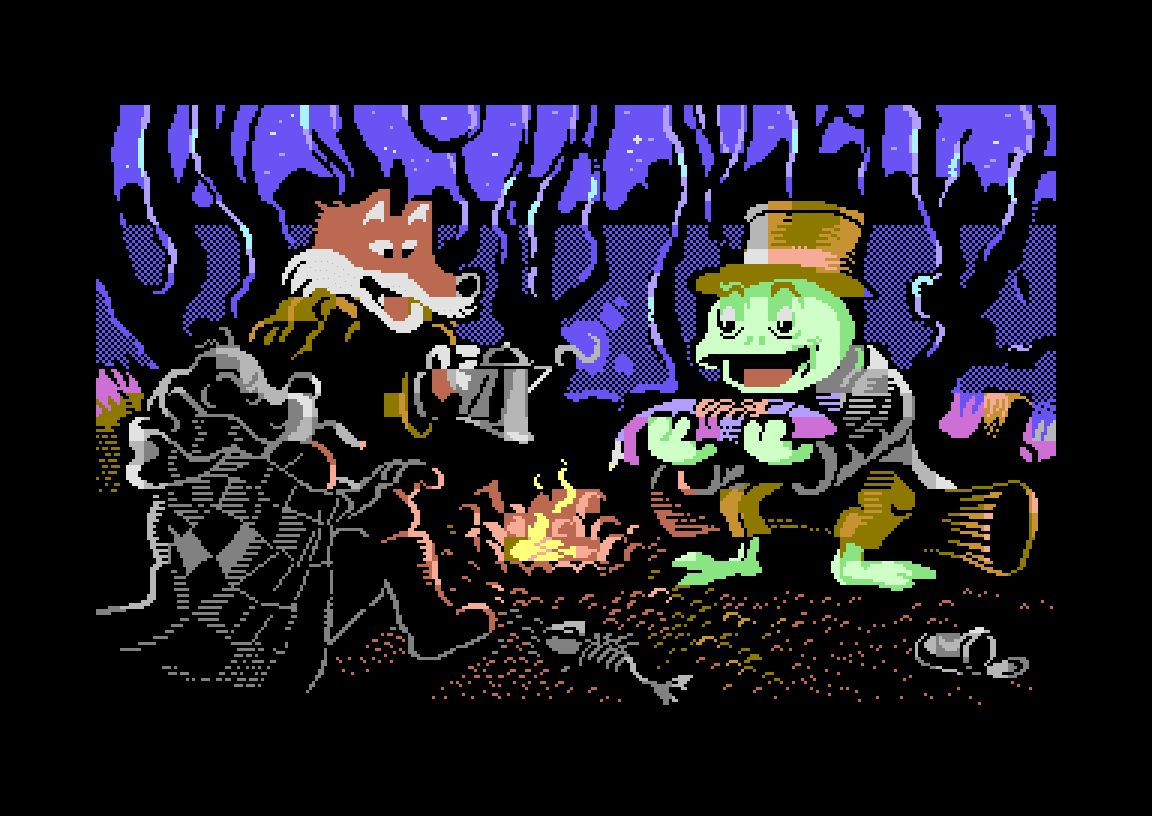
Cartoonzone workstage inside Gfxlab

Here I liked exploring the use of both extended and non-extended sprites in the same picture, and finding a fitting context for each.

There's some actual Commodore 64 game goodness coming out too. My reluctance to discuss on-going game projects means it will have to wait, but it's now safe to say it should be complete in 2023.

Then a few examples of C64 PETSCII and bitmap images.

Ego The Living Planet

Above, Ego the Living Planet PETSCII and below Night of the Homeless at the Vammala Party graphics compo. This is a plain hires without sprites.

Asunnottomien Yö

Oh, and one of my older works, Countryside, was printed and exhibited in the Pixeled Years exhibition at the Game Museum in Vapriikki, Tampere, Finland. Some of my other works were included in the rolling slideshow along a bunch of Finnish bitmap C64 art.

Multipaint running on a PC was also displayed opposite to a joystick-driven Advanced Art Studio, to also give an idea to the visitor how the conditions for making images differs. The exhibition, curated by Electric and Duce of Extend, is still running.

The panel discussion at the exhibition, alongside heavy presence and comments at the Zoo'22 demoparty (and an experience in tutoring the platform at a university) did make me reflect on my role as the tool creator. I'm now thinking that the resemblance to a 1980s/1990s paint program is actually a good thing and shouldn't be ruined by trying to add too many features.

Pictures at an exhibition

Talking of Advanced Art Studio, recently I've dug out some of my old C64 floppy disks in the expectation I could find some hilarious BASIC gems and pictures from around 1989-1990. This was helped by SD2IEC SD card reader and JaffyDOS program which allows me to create D64 disk images, using the real 1570 drive as a source.

It turns out the treasure was not as abundant than I had hoped for. The BASIC programs tended to be short and unfinished. It's also tricky to piece together the few machine code and sprite materials which generally don't have any kind of loader built-in.

But there was a nice instant payoff in the form of a couple of graphic artefacts, such as this copy of a cover from a Traveller 2300AD Role Playing Game extension Kafer Dawn.

1990: Traveller 2300AD

I'm fearing that my earliest programs are not present, as my findings looked like they were from a second wave of creativity. Going through dozens of disks, I no longer think there are any significant "lost disks". The floppies back then were mostly reserved for copied games which tended to have priority and I could have overwritten my programs on a whim. The same was even more true for ZX Spectrum tapes, and I have very little or nothing remaining from that era.

I'll return to these in more detail if I get around to examining the BASIC program disk contents.


Interlude

The blog saw slightly more MIDI minded postings recently. It is as if I finally have the kind of setup I envisaged at late 1990s, never mind actually producing something with it. Maybe it is a kind of eternal "garage project".

I have continued to work on a sequencer that combines tracker and piano-roll editing into some kind of fake Atari ST/Amiga sensibility, partially hard-coded to the kind of equipment I happen to have. MIDI only, no VST support. Again, this is unlikely to be released, there is enough such software out in the wild and I don't want to be answerable to this...

Windowman

This project which I've only called Miditracker, and its latest incarnation, Windowman, has obviously been under development before 2022. It has a some sort of genealogy dating back to late 1990s. Now was simply the year when it began to feel more fully formed.

Games

I felt I played less games overall during the year, but looking back it's not true. At the beginning I did complete Control, after which I had a long pause from larger games.

Control

Control was more action-oriented than I expected. Cleverly the confined setting doesn't require so much content creation (I suspect) so the focus is instead on the explosive encounters and modulating this experience almost endlessly through power-ups and weapon variations. The story and the underlying mystery didn't captivate me so much, but the milieu and the relatively banal environment are well done. At some point I simply wanted to be good enough to beat the game.

I still used GeForce Now to stream the game, which was surprisingly doable. But overall I became weary of streaming games. Too random selection of games, the streaming can hiccup and a game can just as well crash remotely as they do locally. After returning to non-streamed games it felt like a breath of fresh air.

Gris

The largest game was Jedi: Fallen Order, which despite some hiccups and crashes could be finished in Linux/Proton. I have to say Linux has come far from Quake and Tux Racing, although in a sense these Proton-games aren't "true" native Linux games. Apparently Proton can run some games better than Linux native versions, though.

Generally, somewhat smaller and just so slightly older games work almost always on Proton without even fiddling anything.

Jedi was a fine game, but surprisingly it wasn't that different from Tomb Raider, or I guess almost any third person action adventure these days. The guy is even explicitly raiding tombs.

Jedi: Fallen Order

Towards the end of the year, I picked up pace and completed Rise of the Tomb Raider, then Gris. The Tomb Raider sequel didn't have the same impact as the 2013 reboot, being mostly more of the same.

Gris was stylish and enjoyable, occasionally utilizing the simplest of 8-bit game mechanics without the frustration and unfairness that often went with the early games.

I also picked up a bunch of cheap games from the Steam sale which is still going on.

For shits and giggles I got Garfield Kart, which I quickly set aside. 

Garfield Kart

Now I'm looking into the Giana Sisters 2D which I bought on the reputation of the DS game it appears to be based on.

However, the rather nice pixel graphics of the DS version have been translated somewhat unevenly into mobile game vector muck. Sometimes it even refers to the Amiga airbrushed cover art, and the music has some of that Amiga twang too. Can't say how the game play differs from the DS version, which I never played, but it does feel a little clunky at times.

At some point I also completed Great Giana Sisters on the C64, something I've not done since the early 1990s I guess.

I have alternatively numbed and irritated my mind by playing battledudes.io, which I might be finally leaving behind together with surviv.io and the like.

Giana Sisters 2D

TV, Books, Film, Star Wars

After getting the Chromecast dongle and discovering streaming apps for Android, we've been watching this and that, opening and closing subscriptions as needed. I've had Netflix subscription quite permanently, occasionally turning Disney+ and HBO Max on/off. 

The apparently final season of Westworld felt more satisfying than seasons 2-3, but I guess there's little to salvage from that concept from now on. 

What else. Stranger Things, Locke and Key, Bridgerton, Emily in Paris, 1899, Manifest, Witcher, Lucifer, Sandman, Raised by Wolves, Discovery of Witches, The Nevers...

Although it looks like this should make me a couch potato, it was achieved by watching one series at a time, 1-2 episodes per evening.

The Doctor in Doctor Who was finally reincarnated. The final hurrah was better than most material from the recent years, but still a far cry from the most glorious seasons. Given the new series has been going for 15 years (sigh), it's not surprising it had to go through a bad patch. Now there's some signs of course-correction, but this isn't usually a very promising artistic direction.

If anything, you'd think Star Wars would be that one pop-culturally over-saturated, over-ripe thing that would better lay down and rest for a while. But I did binge on Star Wars during summer. The expectation of the Kenobi series led me to watch the films in episodic order, up until Kenobi, then after the series I followed with Rogue One, the original trilogy and the sequels. (I left out Solo).

Some of my Star Wars junk

I have to say the prequels felt slightly better than before, whereas my previous assessment of the sequel trilogy as "better than prequels" began to feel doubtful after this proper re-watch. At least the Rise of Skywalker was pretty dire. The film dives into depressing depths through Palpatine's return with a killer fleet, the stupid hyperspace-skipping scene, the Sith dagger plot... Yet strangely the film managed to end on a reasonably high note and cast an arc back to the prequel themes.

Disney+ keeps churning out Star Wars. Mandalorian season 2 wasn't as triumphant as the first one, relying more on cartoonish characters, fan service and pushing the uninteresting Mandalore mythos. Still all in good fun. Book of Boba Fett was enjoyable but tended to derail from its premise and ended up with prequel-style hijinks. I liked Kenobi better, because it was bold enough to take central characters and bring a kind of emotional closure to the Vader/Kenobi interactions the prequel trilogy lacked.

Star Wars: Andor was in some way what I always feared a live action Star Wars series might be like, before any such existed. Talky drama, low on fx and action, 99% planetside... However they managed to make it compelling, mixing genres and ideas not usually seen in Star Wars. What was the Imperial bureaucracy like, mentioned off-hand in the first Star Wars film? What's the world like outside the Skywalker saga and force-users? My main gripe is that as season 2 became a certainty, various plot threads were vaguely non-committal by the end of this first season.

All this re-watching and watching was capped with reading the famous Star Wars "Thrawn trilogy" books. Short verdict: it wasn't that impressive to me. Perhaps you had to be there, a kid in the early 1990s, starving for more Star Wars and buying into the idea this was the "sanctioned, official sequel" to the film trilogy. Bullshit! I do not think these novels would have made a great premise for a film trilogy or TV series.

Otherwise 2022 wasn't a huge year for sci-fi reading, but I did get into Liu Cixin's Thunderball, and lately, Carl Sagan's Contact. At some point I also re-read Fred Hoyle's Black Cloud. Through serendipity, the themes of these books were not that far apart from each other, life careers in science conflict with politics, military and religion.

Thursday, 15 December 2022

HP Elite Display and 50Hz


So I broke my primary display. For a while I suffered an old Benq display with 1920x1080 resolution, but then replaced it with this used cheap-ish 24" HP EliteDisplay E243i with a 1920x1200 resolution.

I was not initially too impressed with it. It is not completely flicker-free technology although the flickering is not nearly as obvious as the one used in the Benq. (And I barely noticed it there until it was pointed out to me.)

On the positive side, it is pleasing as an object, the frames are thin, doesn't shake excessively, pivoting is extremely easy and goes both directions. Connections are Displayport, HDMI and VGA.

But I probably wouldn't write about this without a happy accident: the display has 50Hz refresh rates. 

These only work for the 1920x1080, 1280x720 and 720x576 resolutions. In practice the 1280x720 is used if a 50Hz HDMI is plugged in.

This is desirable for various more or less "fake" retro applications and emulation, as the old computers tended to use 50Hz refresh rate in Europe. I had been actively searching for such a possibility, but gave up as apparently only TV displays have such rates.

For modern displays, having 50Hz input does not always mean the frame rate is 50Hz, as it could be simply some kind of auto-conversion to 60Hz. Also, horizontal frequencies matter. For example, the ZX Evolution computer VGA is quite picky and the display couldn't catch the signal.


Converted image

I first tried an old Composite-to-VGA box and got a very cruddy Commodore 64 image on the display. Despite the poor quality, the frame rate is rock solid, with no indication of stuttering or 50-60 conversion.


Changing to S-video, the image improved marginally.

The box also takes in Y-U-V, which likely would be the best option for this video converter, but the C64 signal doesn't split that way.

Sticking C64 Composite and Luma outputs into these inputs produced a rather stable and crisp, but wrongly colored, striped image. Don't try at home.


Emulators and other boxes

Even with 50Hz, this display will never be on par with a CRT. The most egregious difference is of course the screen shape. Yes, the monitor can be told to do 4:3, which is a bonus, but it won't take the physical dimensions away.

I tried some emulators and the various HDMI-outputting retro gear I have around. This isn't a review of these platforms, just my experiences with the display and while I'm at it, notes on the Arduino joystick adapter.


UAE

Amiga emulator on Linux. The emulator is surprisingly smooth, and tearless after checking on the vsync tick box. But for some software, the frame rate is not endlessly rock solid. Already looking at the Giana Sisters intro screen I could on occasion see the scroll hiccup a frame. 

But during games and the few demos I tested, I could not really see any problems at all. I guess it partly depends on how the sync is achieved at the "Amiga" end too.

The interlaced Giana Sisters intro screen does not "interlace", and on occasions the lines are displayed in the wrong order.

Using the Arduino adapter, I can play games with the Tac-2 joystick, which is a bonus.


Amiga Mini

Yes, this commercial game console works rather fine and can be set to 50Hz mode. 

The interlaced Giana Sisters intro screen is displayed correctly. The screen scaling options are not very sophisticated, so the screen can end up either small-ish in the center or a big screen with scaling artefacts when scrolling.

The Arduino adapter doesn't work here, so I have to use either the supplied gamepad or the Joystick from The C64. Neither are especially good.


Vice

Commodore 64 Emulator on Linux. Vice adapts to 50Hz but on my Linux/compositor the emulator doesn't quite achieve smooth sync. No clue why and there are really no further options in the GUI at least.

C64 is not pure 50Hz so there might be a systematic hiccup here and there, but at times I felt Vice hiccuping a little more than I'd expect. I am also wondering if the emulator creators really bothered to enforce the slight difference, but perhaps cycle exact is cycle exact.

The Arduino joystick adapter works here nicely, though.


C64 BMC

A Raspberry Pi -based "bare metal" emulator with HDMI out. It needed some fiddling with parameters before I could get an integer-based display scaling, fortunately these can be done from the BMC menu itself.

This was not altogether satisfying, as to get a huge screen with integer scaling, the borders had to be sacrificed. If borders are included, then the usable screen area becomes rather small. In many games it matters little as the borders are often black.

I have to say I'm not exactly sure why the rest of the screen can't be used, there may be still something to explore.

Aahh...

As I've modded the BMC to have original C64C keyboard and a 9-pin joystick port, the experience is quite good and I can directly use my Tac-2.


The C64 Maxi

The commercial hardware emulator. With only HDMI out, no doubt it can do the job. There's also a selection between 50 and 60Hz modes, but as I recall this had to be done at the boot.

Selecting the "pixel perfect" mode I get a pleasant enough, unnaturally crisp HDMI C64 image with borders, something that was a little tricky to get out of BMC.

What is less pleasant is that I'm apparently stuck with the joystick that came with The C64, the Arduino Joystick adapter could not be used here.

Apparently to have more HID devices accepted by The C64, there's a workaround but I'm not yet prepared to go there. Still, it's promising that this problem has a solution too.

I get a good image more easily than with the BMC, but the BMC has better joystick options and is possibly a little less laggy.


The Outcome

So, all in all I think the Linux can do UAE rather well, and for more frame-accurate C64 emulation I have two choices with this display.